Sugar cravings can feel personal, like a character flaw. They aren’t. Most people who search EFT for Sugar Addiction don’t lack discipline; they have a nervous system that learned sugar equals relief. Once that association is established, especially under chronic stress, poor sleep, and midlife hormone shifts, willpower rarely prevails for long.
This guide explains what EFT tapping is, what research suggests, and how to use EFT for Sugar Addiction in the moment and at the root-cause level, without turning your life into a never-ending diet project.
EFT for Sugar Addiction
EFT for Sugar Addiction uses Emotional Freedom Techniques (often called EFT tapping) to reduce the intensity of sugar cravings and the emotional pressure behind them. The method combines focused attention on a craving or trigger with gentle tapping on specific acupressure points. In plain terms, EFT for Sugar Addiction helps your body shift out of fight-or-flight so your brain stops treating sugar as an emergency solution.
That emergency solution part matters. Many cravings don’t come from hunger; they come from stress chemistry, habit memory, and a learned need for comfort. A craving may show up as urgency, tunnel vision, bargaining, or a strange sense that I won’t feel okay until I get it. EFT for Sugar Addiction is designed for exactly that moment, because it gives you a way to reduce the internal pressure before you try to make a decision.
People often ask whether sugar addiction is real. Clinicians don’t diagnose sugar addiction as a formal disorder the way they diagnose a substance use disorder, and the clinic notes you can’t be diagnosed with sugar addiction at this time, even if dependency patterns feel very real. Still, the lived experience, loss of control, frequent use, and persistent preoccupation can look and feel addiction-like, especially for those with a history of alcohol addiction or other compulsive coping patterns. EFT for Sugar Addiction sits in that practical lane: it addresses the craving loop without requiring you to label yourself.
Why sugar cravings feel addictive, even when you hate the pattern
Cravings tend to run on two tracks at once. The first is physical: blood sugar swings, dehydration, skipped meals, and poor sleep can raise appetite hormones and make quick energy more appealing. Research highlights that sleep affects leptin and ghrelin signaling, and poor sleep can make cravings more difficult to resist.
The second track is emotional: sugar becomes a fast way to change state. Stress, resentment, loneliness, pressure, boredom, and I deserve something all create a pull toward relief.
EFT for Sugar Addiction aims at the second track directly while still respecting the first. If your body is under-fueled, overtired, or stressed, cravings roar. When your nervous system calms, choice returns.
EFT tapping basics: What you do and why it can calm the stress response
EFT is a self-care approach that involves tapping on acupuncture points while repeating emotionally charged statements related to a specific issue, and it notes sugary junk cravings can be targeted with tapping. The Tapping Solution, a major publisher in the EFT space, frames tapping as a mind-body approach that combines modern psychology with acupressure while focusing on the issue at hand, to send a calming signal to the brain.
So EFT for Sugar Addiction isn’t about positive thinking your way out of cravings. It’s about reducing the body-level alarm that makes sugar feel necessary. Once the alarm drops, you can address food choices without white-knuckle intensity.
Sugar cravings, chronic stress, and the midlife body connection
If EFT for Sugar Addiction had one secret, it would be this: cravings often rise when your system feels unsafe. That can mean old trauma, current overload, grief you never metabolized, or a lifestyle that leaves no margin. It can also mean midlife physiology that changes how stress and sleep affect appetite.
Research points out that stress hormones play a big role in sugar cravings and that movement can reduce stress. That’s the mainstream version of what many women over 40 already sense: stress makes cravings louder. EFT for Sugar Addiction uses that reality as the starting point rather than the afterthought.
Below is a simple map you can use to spot which track drives your cravings most often. EFT for Sugar Addiction works best when you target the track that’s actually running the show.
| Common trigger | What it feels like in real life | What does EFT for Sugar Addiction target first |
| Skipped meals, long gaps, “too busy to eat.” | Sudden urgency, shakiness, “I need sugar now.” | Panic/urgency signal before you decide what to eat |
| Poor sleep | Intense morning cravings, late-night grazing, low patience | The stress reactivity that makes cravings feel unavoidable |
| High-pressure days, decision fatigue | “I deserve this,” “I can’t do one more thing.” | The need for relief, not the sugar itself |
| Loneliness, resentment, grief | Eating in secret, numbness, quick comfort | The emotion under the craving stops recruiting sugar |
| Habit windows (nighttime, TV, weekends) | Autopilot, “I’m already doing it.” | The cue-response loop that keeps repeating |
EFT for Sugar Addiction fits well here because it doesn’t require perfect conditions. You can tap in the messy middle of life, before the drive-thru, in the pantry aisle, or five minutes before bedtime when cravings usually win.
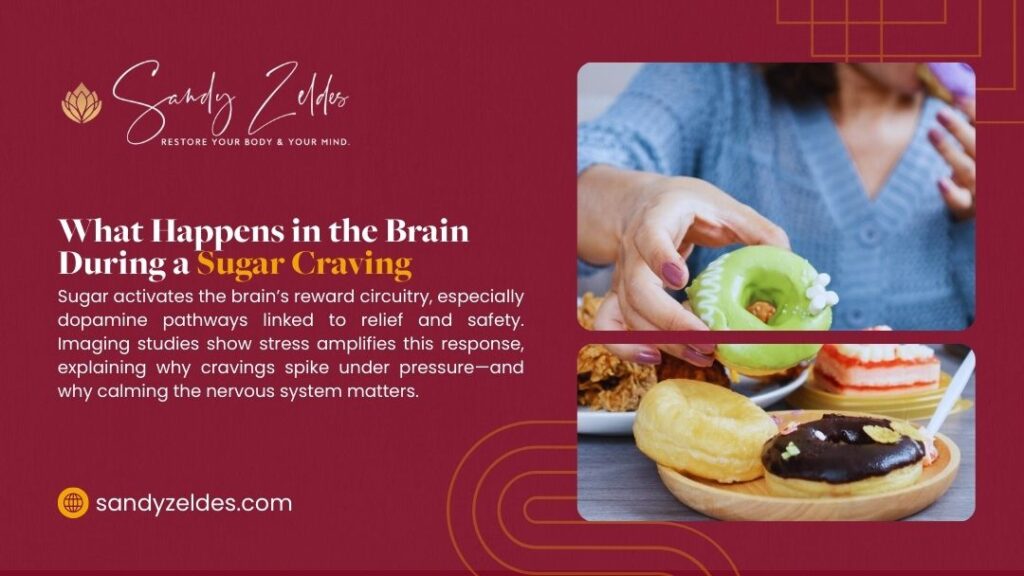
3 ways to use EFT for Sugar Addiction
EFT for Sugar Addiction has three practical entry points. You can use one or rotate all three depending on what your week looks like.
Protocol A: In-the-moment craving relief (about five minutes)
This is the version you use when your brain says, Now. The Tapping Solution outlines a simple approach: identify the craving, rate intensity 0–10, create a setup statement, tap through points while focusing on the craving, then re-rate and repeat if needed. For EFT for Sugar Addiction, the key is to name the real experience, not what you think you should feel.
Start by rating the craving intensity from 0 to 10. Say the number out loud. Then use a setup statement that tells the truth without drama, such as: Even though I want sugar right now, and it feels urgent, I accept myself, and I’m open to calming my body. Tap through the standard points while you repeat short reminder phrases: This urge, This pressure, This ‘I need it now’ feeling, This sugar pull.
Stop and re-rate. If you dropped from an 8 to a 5, you’re not done, you’re back in choice. Do another round and target what’s left: This leftover craving, This tension in my chest, This need for relief. EFT for Sugar Addiction is iterative; you’re peeling layers, not winning a single heroic battle.
Protocol B: The root-cause session (when the same craving repeats)
If you only use Protocol A, you may get relief but still repeat the pattern every night. Protocol B is for the repeating loop: the same time, the same snack, the same. I’ll start tomorrow.
Cravings are framed as anxiety-related sedation, where food acts like a drug to calm internal discomfort, and it describes tapping as a way to address deeper emotional drivers. That’s the spirit of Protocol B. EFT for Sugar Addiction becomes far more effective when you ask one blunt question: What feeling does sugar help me avoid right now?
Name the feeling without polishing it. Pressure. Loneliness. Anger. Grief. Boredom. Then tap on that, not on sugar. A setup statement might sound like: “Even though I feel totally overwhelmed, and sugar feels like the only break I get, I accept myself and I’m open to relief that doesn’t cost me.” Tap and speak directly: “This pressure,” “This tight chest,” “This ‘I can’t do one more thing’ feeling,” “This old pattern.”
When you do this, EFT for Sugar Addiction stops being a craving trick and becomes a nervous-system intervention. That’s when the peace with food part becomes believable.
Protocol C: The relapse-loop breaker (before your trigger window)
This is the underused strategy that changes everything for a lot of people: tap before the craving appears. If your danger zone is 9:30 p.m., tap at 9:10. If weekends trigger it, tap before you leave work on Friday. If driving past a certain store triggers it, tap in the car before the route.
EFT for Sugar Addiction works well as prevention because your brain doesn’t have to fight a fully activated craving. You’re teaching your system a new default: calm first, choice second.
Willpower fails, sugar detox can backfire, and that’s why it matters
A lot of break sugar addiction advice relies on strict avoidance, perfection, or a 10-day reset. It emphasizes the importance of eating balanced meals regularly without skipping them, getting enough sleep, staying hydrated, moving your body, and planning meals thoughtfully. It also notes that the body needs sugar in the form of glucose as energy, but it doesn’t need added sugars, so trying to completely avoid all sugar in a realistic diet, especially from natural food sources, isn’t necessary.
That distinction matters because many women who search EFT for Sugar Addiction already tried white-knuckle rules. They don’t need more rules; they need a method that helps their body stop interpreting sugar as relief.
EFT for Sugar Addiction doesn’t argue with nutrition. It complements it. If your meals stay protein-poor, your sleep stays short, and your days stay overloaded, cravings will keep knocking. But once you add EFT for Sugar Addiction, you stop treating cravings as a moral failure and start treating them as a signal, often a stress signal. That shift alone reduces shame, which reduces the “screw it” binge that follows a slip.
If you want one concrete benchmark, use public health guidance. The American Heart Association suggests women limit added sugars to about 25 grams per day. Many people exceed that without realizing it, especially through drinks, sauces, healthy bars, and flavored yogurt. EFT for Sugar Addiction helps with the emotional pull; balanced eating helps with the biochemical swing. Together, they’re far stronger than either one alone.
When EFT is not enough, and when to seek more support
EFT for Sugar Addiction can be a powerful tool, but it is not a substitute for medical care, therapy, or structured addiction treatment when those are needed.
If sugar is replacing another addiction, if eating patterns feel compulsive and frightening, or if you suspect an eating disorder, professional support matters. Sugar dependency can show up more often in people who attempt to stay sober in other areas, such as alcohol.
If you’re in that category, EFT for Sugar Addiction can still help, but it works best inside a wider support plan that may include therapy, a clinician, or community support.
If you feel drawn to a structured recovery culture, some people benefit from a rehabilitation or outpatient rehab framework, and others benefit from community programs such as 12-step support groups.
Those programs exist for alcohol use disorder and other forms of addiction; they can also help with the isolation and codependency patterns that sometimes surround compulsive coping. The point is not to scare people. It’s to be honest: EFT for Sugar Addiction is a skill, not a miracle, and serious suffering deserves serious support.
A practical 7-day plan that blends EFT for Sugar Addiction with real life
Most people quit after a good day collapses into a bad night. This plan keeps it realistic. It isn’t a diet. It’s a short experiment to help your brain learn that calm can come first.
| Day | Focus | What you do with EFT for Sugar Addiction | What you track |
| 1 | Awareness without judgment | Tap once during a craving, even if you still eat sugar | Craving intensity before/after |
| 2 | Sleep and cravings | Tap at the time cravings usually appear | Whether cravings shift with rest |
| 3 | Stress trigger | Tap on the feeling under the craving, not the food | Emotion label that fits best |
| 4 | Habit window | Pre-tap 15 minutes before your danger zone | Whether the urge arrives quietly |
| 5 | “I deserve it” loop | Tap on reward, resentment, pressure | What you really need (rest, comfort, connection) |
| 6 | Social or weekend cues | Tap before the cue (store, event, TV) | Whether you feel more choice |
| 7 | Review | Tap on doubt and “it won’t work for me.” | What improved, what still needs work |
EFT for Sugar Addiction works best when you treat it like a nervous-system practice, not a one-time emergency button. Some days you’ll still eat the sugar. That’s not failure. That’s data. You tap on the data.
FAQs: EFT for Sugar Addiction
How effective is EFT for sugar addiction recovery?
EFT for sugar addiction can be highly effective for reducing the emotional intensity behind cravings. Research suggests EFT tapping may lower stress hormones like cortisol, which are linked to compulsive eating patterns. While it is not a standalone cure, many people find that EFT helps them feel calmer and more in control, making it easier to break the craving cycle and build lasting habits.
What is the best treatment for sugar addiction?
The most effective approach to sugar addiction combines emotional, behavioral, and nutritional support. This often includes stress management, balanced meals, and techniques like EFT tapping to address the underlying emotional triggers. A one-size-fits-all diet rarely works long term, so sustainable change usually comes from addressing both the body and the nervous system together.
What deficiency causes sugar cravings?
Sugar cravings can sometimes be linked to deficiencies in nutrients like magnesium, chromium, or protein. However, not all cravings are nutritional. Many are driven by stress, fatigue, or emotional needs. That’s why approaches like EFT for sugar addiction focus on calming the nervous system alongside improving nutrition.
Can EFT tapping stop sugar cravings instantly?
EFT tapping can reduce the intensity of sugar cravings within minutes for some people, especially when used during the peak of a craving. However, lasting change usually comes from repeated use over time, addressing both immediate urges and deeper emotional patterns.
How long does it take to break sugar addiction with EFT?
The timeline varies depending on the individual and the underlying causes of their cravings. Some people notice relief within days, while others need consistent practice over several weeks. EFT works best as a regular habit rather than a one-time fix.
Is sugar addiction real or just a habit?
Sugar addiction is not officially classified as a medical disorder, but many people experience addiction-like patterns such as cravings, loss of control, and repeated use despite negative consequences. Whether labeled as addiction or habit, the experience is real, and tools like EFT can help address the underlying drivers.
Next steps toward lasting peace with food
If you want EFT for Sugar Addiction to feel less like a tactic and more like a permanent shift, pair it with a structured approach that addresses subconscious patterns, stress load, and the midlife body. Sandy Zeldes’s work centers on that inside-out framework, with EFT and nutrition used to resolve the deeper drivers behind compulsive cravings; her overview of a science-informed tapping approach can help you understand the method more clearly in a weight-loss context.
If you’re ready to put EFT for sugar cravings to a real-world test, with structure, accountability, and professional support, contact us and see whether it’s the right fit for you.