If you keep asking yourself, why do I sabotage my weight loss every time, you’re probably tired of hearing the same old advice. Eat less. Move more. Try harder. Be more disciplined. But here’s what I’ve seen again and again with women over 40: the problem usually is not that you don’t know what to do. The problem is that something deeper keeps pulling you back into the same pattern.
That deeper layer often has nothing to do with laziness, lack of intelligence, or not wanting it badly enough. It can come from chronic stress, old emotional conditioning, all-or-nothing dieting, hormone shifts, poor sleep, or a nervous system that has learned to use food as relief. And when that’s the real issue, more pressure usually makes things worse, not better.
The CDC notes that healthy weight loss is usually gradual, around one to two pounds per week, and that factors such as stress, sleep, medicines, medical conditions, hormones, and age can all affect weight management. That matters because many women who think, “I’m eating healthy but not losing weight,” are blaming themselves for something that is far more complex than calories on paper.
This article explains why you sabotage your weight loss every time, uncovering the real causes behind cravings, plateaus, stress eating, and stubborn weight so you can finally understand what’s really happening and start creating lasting change.
Why do I sabotage my weight loss every time?
Most women who ask, why do I sabotage my weight loss every time, are not really sabotaging themselves in the way they think. Sometimes they are in a normal slowdown and mistake it for failure. Sometimes they are working out but not losing weight because water retention, muscle gain, or metabolic adaptation is masking fat loss.
Sometimes they eat less but do not lose weight because stress drives cravings, sleep is poor, or the body is pushing back against restriction. And sometimes the truth is more emotional: food has become comfort, numbness, reward, rebellion, or a way to soften a hard life.
That’s why this question is so loaded. It sounds like a weight-loss question, but underneath it is often a trust question. Why can’t I stay consistent? Why do I do well for a few days and then unravel? Why is it so hard to lose weight when I know so much? Why do I self-sabotage with food?
The answer is rarely, because you’re weak. More often, it’s because your body and mind have linked food with safety, relief, and regulation. A broader perspective on this root-cause approach looks at how subconscious blocks to weight loss can keep many smart, capable women feeling stuck despite consistent effort.
The scale may be stuck, but that doesn’t always mean you are
This is where a lot of women get tripped up. They assume no movement on the scale means no progress. But weight is not the same thing as body fat, and a stalled scale is not always proof that something is wrong.
Study explains that as you lose weight, your metabolism declines and your body burns fewer calories than it did at a higher weight. That means a weight loss plateau is not unusual. It is part of the process for many people. In early phases of a diet, weight can also drop faster because glycogen and water shift before fat loss becomes more obvious.
Here’s a cleaner way to look at it:
| What you notice | What it may actually mean | What to check next |
| The scale hasn’t moved for two weeks | Water retention, cycle shifts, muscle gain, or a real plateau | Waist, photos, clothes, energy, sleep |
| You’re exercising but not losing weight | Increased hunger, fluid retention, or better body composition without scale change | Recovery, protein intake, stress, measurements |
| You’re not losing weight after 3 weeks of exercise | Expectations may be too fast, or the body is still adjusting | Consistency, sleep, food quality, and patience |
| You’re eating healthy and exercising, but not losing weight | The issue may be hormones, under-recovery, stress, or hidden overeating | Medical history, routine, emotional triggers |
This is why panic so often backfires. Once a woman thinks, “My weight is stuck and not decreasing,” she often responds by tightening the plan, skipping meals, or cutting more calories. But that can make cravings louder and the rebound stronger.
If this pattern feels familiar, the idea that past weight-loss failures do not define long-term progress can help reframe the shame that often keeps the cycle repeating.
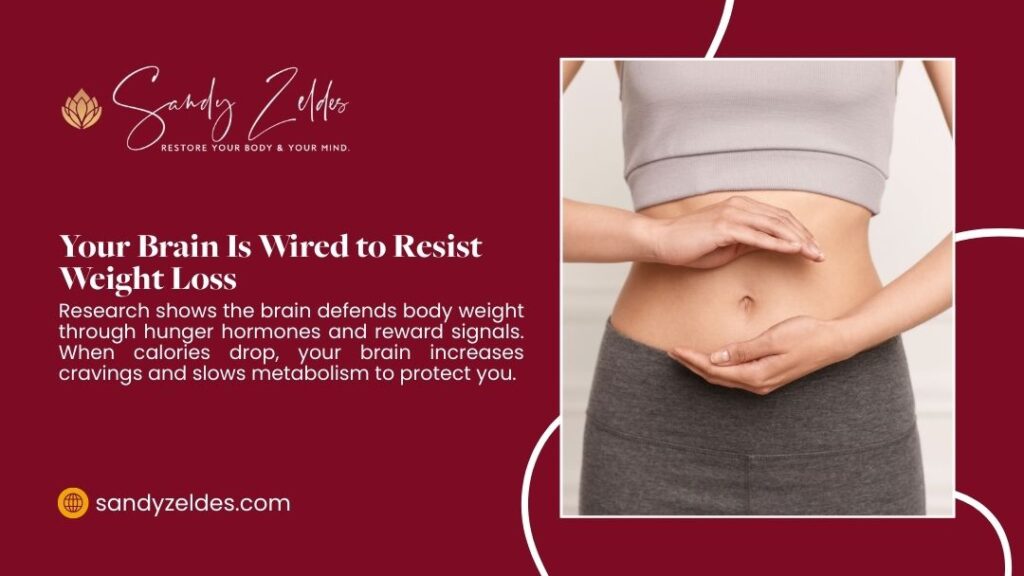
Why does strict dieting keep producing the same ending
A harsh plan can look effective for a week or two. Then life happens. You get tired. Hungry. Busy. Lonely. Overstimulated. Resentful. And suddenly the plan you swore you’d follow feels unbearable.
That is not random. It is one reason that dieting and exercising, but not losing weight, can turn into a full-blown weight loss struggle. The more rigid the plan, the more likely it is to trigger backlash. Some women don’t break the diet because they lack discipline. They break it because the diet itself creates physical and emotional pressure that the body eventually pushes against.
The CDC recommends steady, realistic loss rather than extreme approaches because slower change is more likely to last. NHLBI also notes that even losing 5% to 10% of starting weight over about six months can improve key health markers. In other words, losing 5 pounds in a month may be a reasonable result for some people, but trying to force rapid loss can make relapse more likely.
That’s one reason Sandy’s work does not center on another punishing plan. Her perspective on why there’s no one-size-fits-all diet reframes the issue: when a plan repeatedly fails in real life, the plan itself becomes part of the problem.
Stress is often the hidden engine behind overeating
A lot of women say, I’m not even hungry. So why am I eating? That question matters. If the eating is not driven by physical hunger, willpower alone will not solve it.
A study published in NHI about Eating Behaviors found that chronic stress had a significant direct effect on food cravings, and food cravings had a significant direct effect on BMI. NIH-indexed reviews also show that emotional eating is linked with overeating, obesity risk, and repeated struggles with food regulation.
When a woman asks, Why am I struggling to lose weight? The answer may be that her body is not seeking fuel. It is looking for relief.
That relief can show up after a long workday, during conflict in a marriage, after caregiving stress, when loneliness hits at night, or when old trauma is activated. In those moments, food becomes less about taste and more about regulation. It soothes, distracts, rewards, or numbs.
If that sounds painfully familiar, Sandy has a strong resource on why you eat when you’re stressed, even when you’re not hungry. It gets to the heart of why the problem is often not food at all.
Poor sleep can make weight loss feel impossible
Sleep is one of the first things women dismiss, and one of the biggest things the body notices. When sleep is off, cravings usually rise, appetite regulation suffers, emotional tolerance drops, and the desire for quick comfort gets louder.
A review found that insufficient sleep can undermine dietary efforts to reduce body fat. Another NIH review found that disturbed sleep patterns are associated with increased energy intake, especially from foods high in fat and carbohydrates.
That means someone can be working out and eating right, but not losing weight, while still missing a major driver of the problem. She may not need a stricter plan. She may need sleep, nervous system support, and less stress, as the body does every day.
| Hidden factor | How it can affect weight | Why do women miss it |
| Poor sleep | More hunger, more cravings, less recovery | It feels unrelated to food |
| Chronic stress | More emotional eating, more urge-based behavior | It becomes normal over time |
| Overrestriction | Rebound eating, obsession, loss of control | It gets praised as “being good.” |
| Hormone shifts | Appetite, mood, fluid retention, and fat distribution changes | It gets mistaken for failure |
Hormones, menopause, and medical reasons for not losing weight
Sometimes the issue is not self-sabotage at all. Sometimes the body really is harder to work with than it used to be.
NIDDK states that weight is affected by many factors, including sleep, medicines, health problems, family history, and genes. It also notes that insulin resistance can contribute to weight gain. For women in midlife, hormone shifts can affect appetite, sleep, mood, energy, and body composition all at once. That’s why I’m not losing weight when I exercise, and diet feels like an impossible question to answer.
Hypothyroidism is another example. NIDDK explains that thyroid hormones help control how the body uses energy, and when thyroid levels are too low, body functions slow down. So if a woman is unable to lose weight despite consistent effort, it may be wise to look at thyroid health, insulin resistance, medications, sleep quality, and menopause-related changes before assuming she lacks discipline.
This perspective is also relevant when discussing hormone balance and menopause. It speaks to the real-life experience of women who feel blindsided by a body that no longer responds the way it once did.
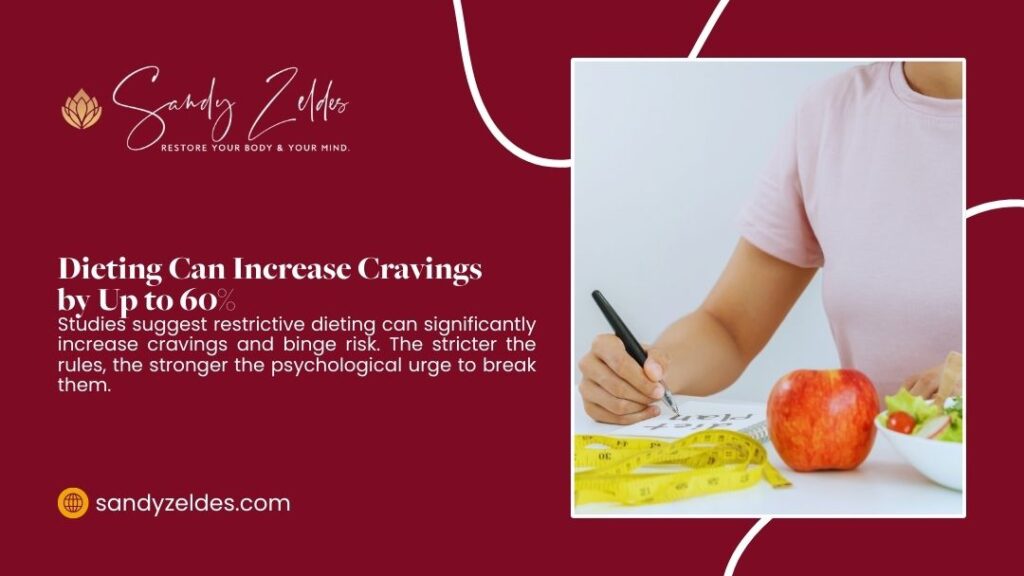
Why food self-sabotage is often a protective pattern
Self-sabotage is usually not random. It is protective. If a woman learned early in life to use food to feel safe, calm, rewarded, soothed, or less alone, that pattern can stay in place for decades. Not because she wants to stay stuck, but because her nervous system believes the behavior helps her survive something.
NIH-indexed research on stress and eating behavior notes that stress is an important factor in addiction and relapse and may contribute to obesity risk. Another review on emotional eating points to emotion dysregulation, high restraint, and stress system disruption as common drivers.
So when a woman says, Why do I sabotage my diet or why do I sabotage my weight loss every time, the real question may be: what is this behavior protecting me from?
This is also where Sandy’s work becomes more specific than standard weight-loss advice. Her approach is centered on women over 40 who are dealing with stress-based cravings, subconscious safety patterns, and food behaviors that no longer make sense on the surface but still feel hard to stop.
Instead of treating overeating as a simple discipline problem, she looks at the deeper emotional and nervous-system patterns driving it. That makes her approach especially relevant for women who feel like they already know what to eat, but still can’t seem to stay free around food.
That is where Sandy’s work stands apart from standard diet content. EFT for emotional eating focuses on how stress-driven eating patterns can begin to shift when the underlying emotional triggers are addressed. EFT for binge eating and EFT for food cravings continue the same discussion by highlighting how emotional responses can influence eating behaviors.
Why women over 40 often feel more discouraged than supported
There is a particular heartbreak in being a high-achieving woman who can run a career, raise children, manage a home, and solve everybody else’s problems, yet still feel powerless around food.
That’s why so many women quietly think, why can’t I lose weight no matter what I do, or even, I’ve tried every diet and still can’t lose weight. They are not lazy. They are exhausted. Many have spent years in diet culture, years overriding their bodies, years trying to force results through pressure and control.
And once a woman starts to believe she is the exception, the one person who will never be free, the struggle gets heavier. The old failures start to feel like identity rather than experience.
This is why Sandy’s perspective on how focusing on dieting can keep women stuck connects closely to this issue. It highlights a common pattern: when control over food becomes the main strategy while deeper emotional wounds remain unaddressed, many women end up repeating the same cycle instead of moving beyond it.
What actually helps when your weight won’t budge
The first thing that helps is accuracy without cruelty. Not self-attack. Not pretending. Just a calmer, more honest look at what is happening.
If you are working out consistently and not losing weight, ask whether the body is inflamed, underslept, overtrained, or compensating with more hunger. If you are eating healthy but not losing weight, ask whether portions, snacking, liquid calories, stress eating, or weekend drift are part of the picture. If you are dieting but not losing weight, ask whether the diet is so restrictive that rebound was almost inevitable. If you are wondering why I am stuck at the same weight for months, ask whether medical screening is warranted.
The next thing that helps is reducing emotional charge around food. This is where body-based tools can be useful, especially for women who already know their issue is not a simple lack of information. Sandy’s share on how to do EFT tapping and her tapping script for weight loss are practical entry points for women who want help with stress, cravings, and self-sabotaging weight loss patterns.
| If your pattern looks like this | A more helpful next step |
| Good all day, overeating at night | Build evening support, not more daytime restrictions |
| Great for a week, then off the rails | Make the plan gentler and more repeatable |
| Constant cravings under stress | Address the stress response, not just the food |
| Scale stuck despite effort | Check sleep, cycle, hormones, meds, and plateau signs |
| You keep starting over | Work on the fear, shame, or belief driving the reset |
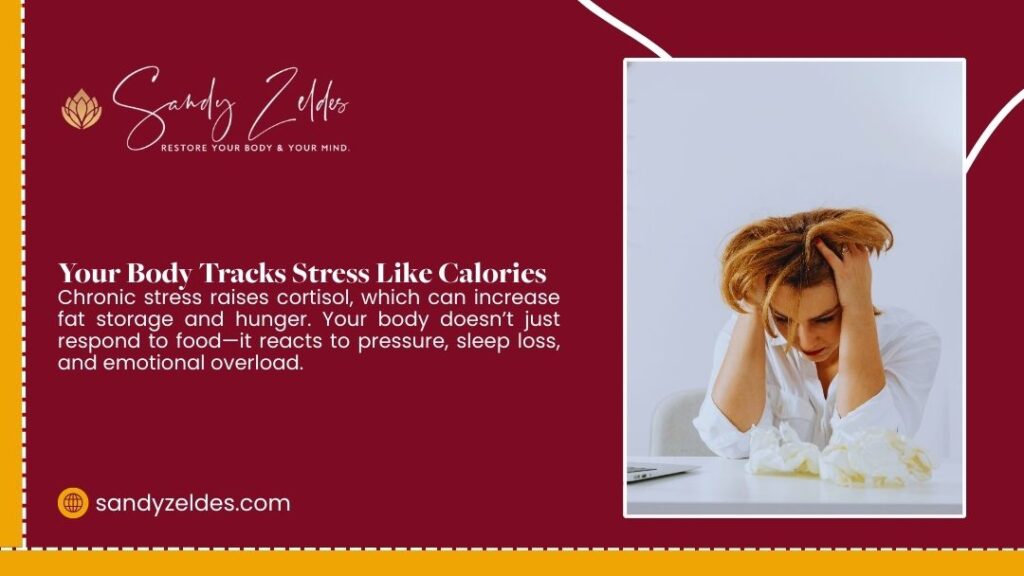
The real shift: stop fighting the symptom and start listening to the message
When women stop asking, What diet should I try next? And start asking, What is my body trying to tell me? The whole conversation changes.
That does not mean ignoring nutrition or pretending weight loss is all emotional. It means understanding that weight loss resistance often has layers. There is the physical layer, the behavioral layer, and the emotional layer. If you only work on one, you often get partial results and then slide back.
This is why Sandy’s broader philosophy about listening to your body carries so much weight. The body is not always the enemy. At times, it raises an alarm, and at other times, it points directly to where healing needs attention.
Where to go from here
If you’ve been asking, why do I sabotage my weight loss every time, take this as your permission slip to stop making the problem about character. The pattern may be rooted in stress, old coping habits, poor sleep, a harsh diet mindset, hormone shifts, or deeper emotional pain that has been mislabeled as a lack of discipline for years.
That’s the good news, even if it doesn’t feel like it at first. Because once you stop treating the symptom as the whole story, you can finally work with the real cause.
If this article sounds like your life, the next step is not another punishing reset. It is learning how to calm the inner pressure that drives the same cycle over and over. A good place to begin is with Sandy’s guide to EFT for emotional eating, which helps connect cravings, stress, and self-protective patterns in a way many women have never been taught before.
If you already know you want deeper support, you can also contact Sandy, explore Sandy’s approach, read client success stories, listen to her podcast conversations, or take the first step with her.
Because the real answer to why I sabotage my weight loss every time is often this: a part of you is trying to protect you, the only way it knows how. And when that part finally feels safe, everything can start to change.