


You may know what you want to change about your eating, yet still find yourself at the pantry after a long day. If you are thinking about EFT tapping, it is reasonable to wonder what you would actually do in a session before you decide whether to try it.
This guide walks you through a typical guided session, from choosing a focus to checking in afterward. My work often involves women navigating food cravings, so I will use that experience as an example. Your session may look different, and you can ask questions before you book.
What Happens in a First EFT Tapping Session? A Quick Preview
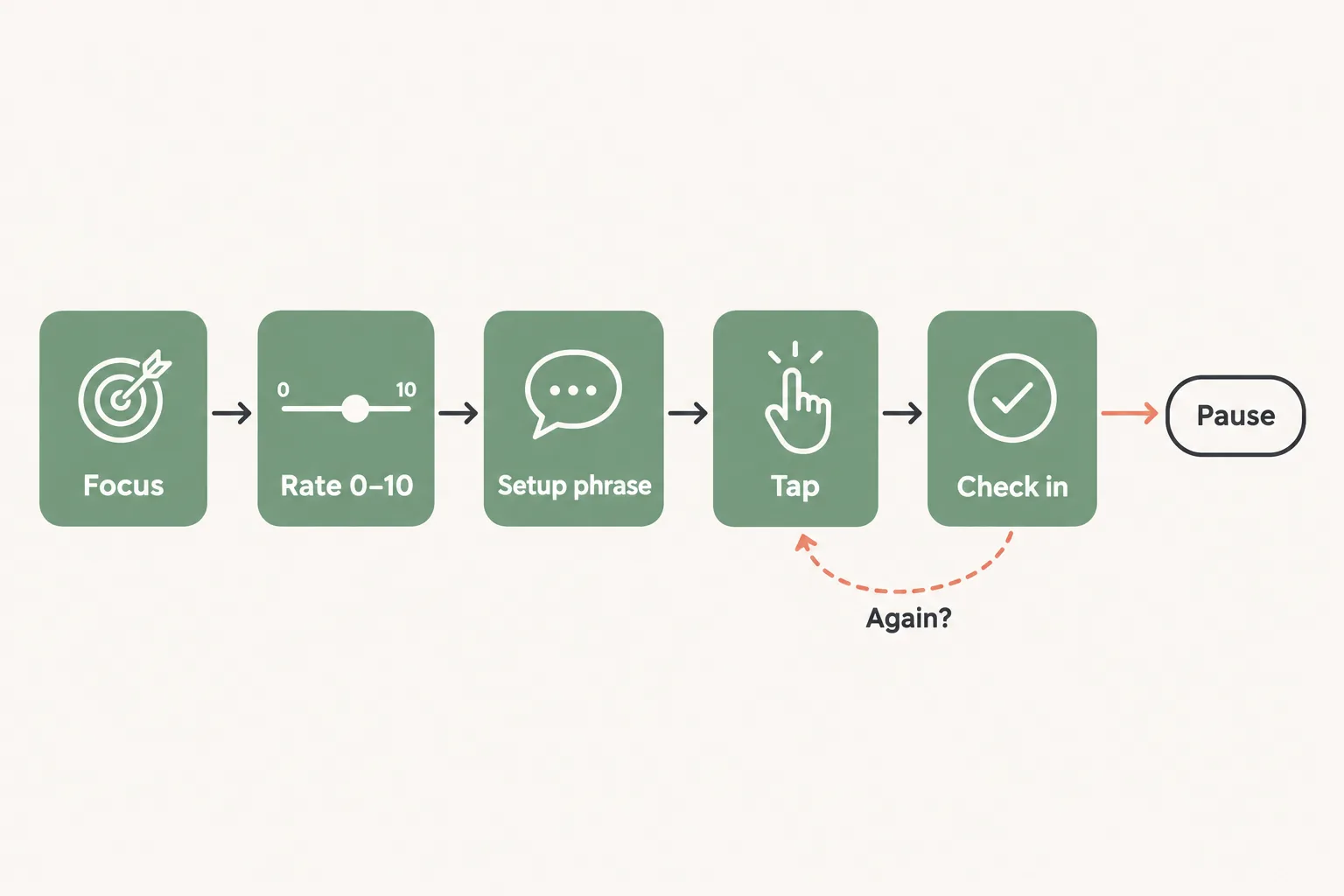
In a guided EFT tapping session, you and a practitioner usually begin by choosing something specific to focus on. You may give the feeling a number from 0 to 10, choose words that describe it, and tap gently on points on your hand, face, and upper body. Then you check in. If nothing changes, you can change the focus, try another round, or pause; a lower number is not a requirement for a successful conversation.
Tapping uses your fingertips, without needles or special equipment. The appointment also includes conversation: you can say what brought you in, ask for clarification, and decide how much you feel comfortable sharing. Session lengths vary, so confirm the length of the appointment you are considering rather than assuming it will last an hour.
Before You Book: Questions About the Appointment
My current work-with-me page describes 1:1 programs by application and separately offers individual sessions. Before choosing a next step, you can ask:
- Am I arranging an individual EFT session or starting a conversation about a longer program?
- How long is the appointment, and will we meet online or in person?
- What happens if I want to pause, change the subject, or avoid discussing a memory in detail?
Those details depend on the appointment; it is better to confirm them directly than to rely on a general description of EFT.
Before Tapping: Your Goal, Questions, and Comfort Level
A guided session may start with questions about what brought you there and what you hope to work on. For someone concerned about emotional eating, that might mean noticing what tends to happen before an evening craving: a difficult conversation, a tiring workday, or a familiar thought about food. You do not have to arrive knowing the cause.
A broad goal such as “I want to stop struggling with food” can lead to a more specific starting point, such as “I feel tense when I get home and head straight for the pantry.” That example is hypothetical; your focus should come from your own experience. You can also tell the practitioner if a topic feels like too much to discuss.
I have worked with women on food and health concerns for more than two decades, and my background includes functional medicine nutrition and advanced EFT practice. You can read more about my background. A craving may be the first thing you notice, but it does not tell us on its own what is causing it.
Step 1: Identify the Specific Issue
You might choose a recent moment, a craving you remember clearly, or a feeling that shows up before you eat. You can start with something manageable; you do not need to bring up your most painful memory to begin.
Step 2: Check In With the Feeling, If Helpful
Some EFT approaches ask you to rate how strongly you feel about the issue from 0 to 10. EFT International’s introduction to tapping includes this check-in before and after a round. The number is subjective: it can help you describe what you notice, but it is not a diagnosis or proof that a problem has been resolved. If a number does not help you, say so.
Step 3: Choose a Setup Phrase You Can Use Comfortably
A common setup phrase names the issue while leaving room for self-acceptance. For example: “Even though I feel tense and want to snack after work, I am open to being kind to myself.” A practitioner can help you find words that sound like you. You can say if a phrase feels uncomfortable or if you would rather not describe an experience aloud in detail.
Related readingEFT for Weight Loss and Self Sabtage | Eat Like A GoddessRead the guide →There is no need to shame yourself into finding the “right” words.
The aim is to acknowledge what you are noticing, at a pace you can handle.
Step 4: The Tapping Sequence and the Points You Move Through
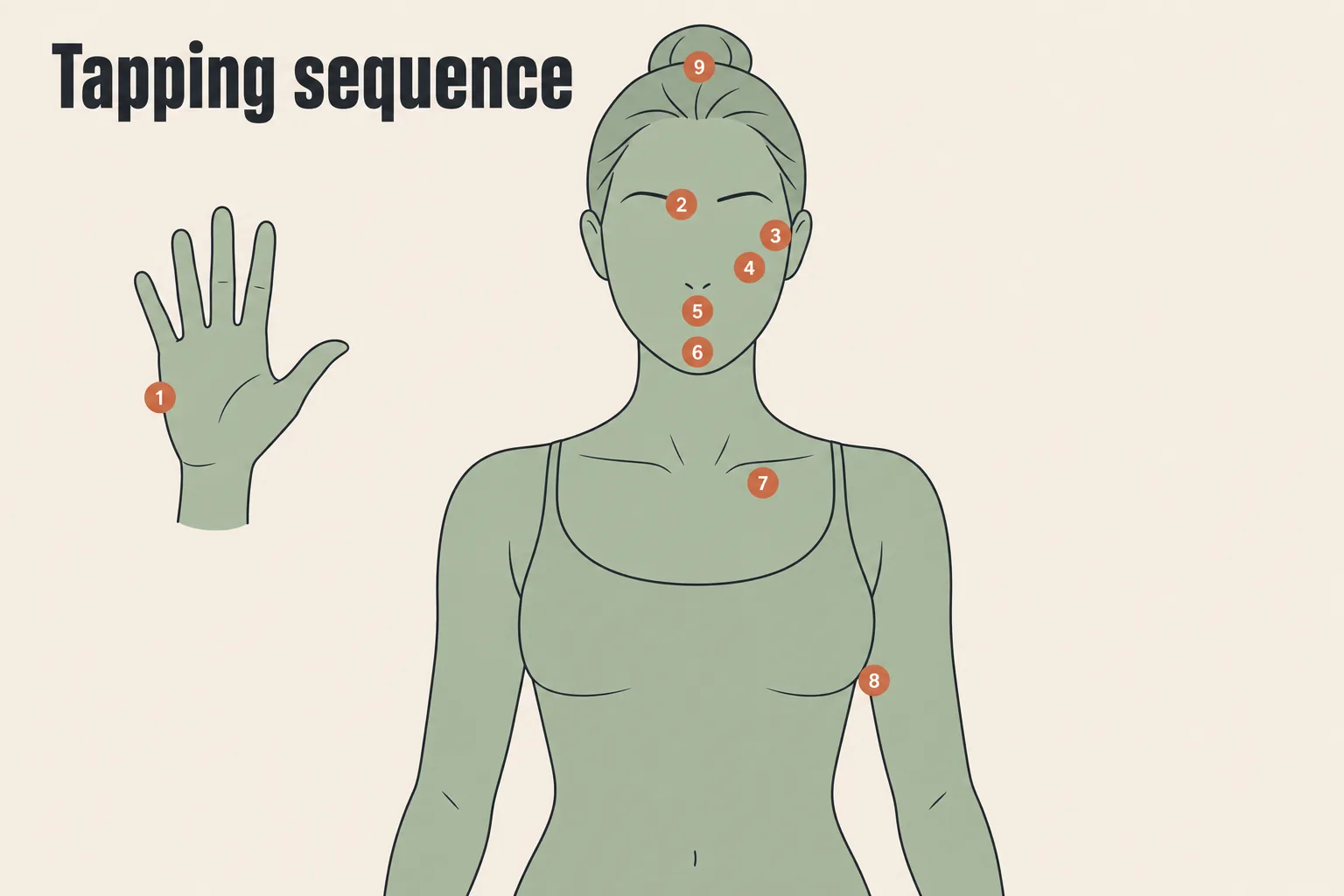
You tap gently with your fingertips while keeping your chosen issue in mind. A common sequence begins at the side of the hand and moves through points around the eyebrow, eye, nose, chin, collarbone, underarm, and top of the head. Cleveland Clinic’s explanation of the points gives a beginner-friendly overview. For a diagram you can keep nearby, see my EFT tapping points chart.
You might use a short reminder phrase such as “this after-work tension” as you tap. Your practitioner can demonstrate the sequence, and you can ask to slow down or skip a spot that hurts. There is no need to interpret a yawn, a tear, or the absence of a physical sensation as proof that the session is or is not working.
Step 5: Check In and Decide What Comes Next
After a round, you can notice whether the feeling, thought, or optional 0–10 rating has changed. It might feel less intense, feel different, or seem unchanged. From there, you and the practitioner can decide whether to tap again, choose another focus, or stop for now.
If a memory comes to mind, you do not have to follow it or tell the whole story. Let the practitioner know what feels manageable. If you want the full instructions for practicing on your own, my step-by-step guide to doing EFT tapping covers the rounds in more detail.
How a Guided Session Differs From Tapping on Your Own
You can learn the basic tapping routine and use it on your own when everyday stress shows up. In a guided appointment, another person can help you choose a focus, explain the points, and check in with you as the conversation develops. That support can be useful if you feel unsure where to start. Neither solo nor guided tapping guarantees a particular result.
If your concern involves significant trauma or a diagnosed eating disorder, ask a qualified healthcare or mental health professional about appropriate care. An EFT coaching session does not replace that care.
What You Might Feel During and Afterward
You may feel calmer, tired, emotional, or much the same as when you arrived. None of those reactions, by itself, tells you whether an underlying pattern has been resolved. Tell your practitioner if something feels uncomfortable, and take a little time afterward to notice how you feel before rushing to the next task.
If you remain distressed after a session, seek support from an appropriate healthcare or mental health professional. You do not have to treat feeling worse as a necessary stage of healing.
How Many Sessions Might You Need
There is no reliable number that fits everyone. The time you choose to spend on EFT depends on what you want support with, what you notice, and whether you want to continue. A change in one moment does not establish that a long-standing pattern has permanently changed. Ask about the format and any between-session practice when considering an individual session or a longer program.
When to Pause or Seek Clinical Support
Pause if tapping feels painful or brings up distress that you do not want to continue exploring. You can skip a sore point, change the focus, or stop. For significant trauma symptoms, speak with a licensed mental health professional who has experience with trauma rather than assuming an EFT practitioner has that clinical qualification.
If you have a diagnosed eating disorder or think you might have one, seek assessment and treatment from an appropriate care team. EFT can be discussed as a complementary practice; it should not replace prescribed care. The National Institute of Mental Health’s eating-disorder resource explains why timely professional care matters.
What Research Can and Cannot Tell You About EFT
EFT research is still developing. The National Center for Complementary and Integrative Health says there is some evidence it may reduce anxiety, while more research is needed. Researchers have not settled precisely which parts of tapping account for reported benefits. For a broader discussion, read what the research says about EFT.
One randomized study comparing EFT with cognitive behavioral therapy reported improvements in food cravings in both groups, but did not find reductions in BMI. That is a reason to discuss cravings and weight separately. A study of group treatment cannot predict what will happen in your first appointment or promise lasting weight loss.
In my work, the useful question is often what is happening around a recurring craving and what kind of support would help you respond differently. It is a question we can explore together, without assuming food is the only factor or promising one explanation for everyone.
Frequently asked questions
Do I have to believe in it for it to work?
Do I have to describe a painful memory out loud?
Will I do the tapping myself?
What if I feel nothing at all during the session?
Can tapping help with weight specifically, or only the emotions around food?
Can I stop or change focus during a session?
Explore One-on-One Support With Sandy
If the after-work pantry moment sounds familiar, you do not need another reason to blame yourself. You can start by talking about the pattern you have noticed and the kind of help you are looking for.
I offer 1:1 programs by application, and my work-with-me page also links to individual sessions. Explore working with me to see which next step fits. You can ask about the appointment format, length, and what you would like to work on before you commit.