


EFT vs EMDR compares two different approaches: EFT uses tapping on body points, while EMDR is a structured psychotherapy with stronger guideline support for PTSD. Neither is established as the best choice for every person who eats in response to stress. Your needs, the evidence for your concern, and the provider’s qualifications matter more than how similar the movements look.
Maybe your therapist mentioned EMDR at your last appointment. You nodded, went home, and started searching. Somewhere along the way you ran into EFT tapping too, and now you’re wondering: are these the same thing? Is one better? And does either one have anything to do with the fact that you’ve tried every diet out there and still end up in the pantry at 9 pm?
For more than 20 years, my work with women has focused on their relationship with food. My background includes professional cooking, nutrition, and EFT. Here’s how these two approaches compare, in plain language, so you can see which one fits what you’re dealing with.
A quick note first: this article is educational. It isn’t diagnosis or treatment advice, and it doesn’t replace guidance from your doctor or therapist.
EFT vs EMDR at a Glance
The clearest difference is the method and the care surrounding it:
-
EMDR means Eye Movement Desensitization and Reprocessing. It uses a structured therapy process that may include eye movements, alternating sounds, or taps. For treatment, choose a licensed mental health professional with EMDR training.
-
EFT means Emotional Freedom Techniques, also called tapping. It involves tapping points on the face and upper body while focusing on a feeling, thought, or concern. People use it for self-help or with a practitioner, whose clinical qualifications may vary.
PTSD means posttraumatic stress disorder. EMDR has an established place in PTSD treatment guidelines. EFT is also studied for distress and cravings, but using it in coaching does not turn coaching into trauma treatment. A coach’s EFT certificate is not a mental health license.
What Is EFT Tapping, in Plain Terms?
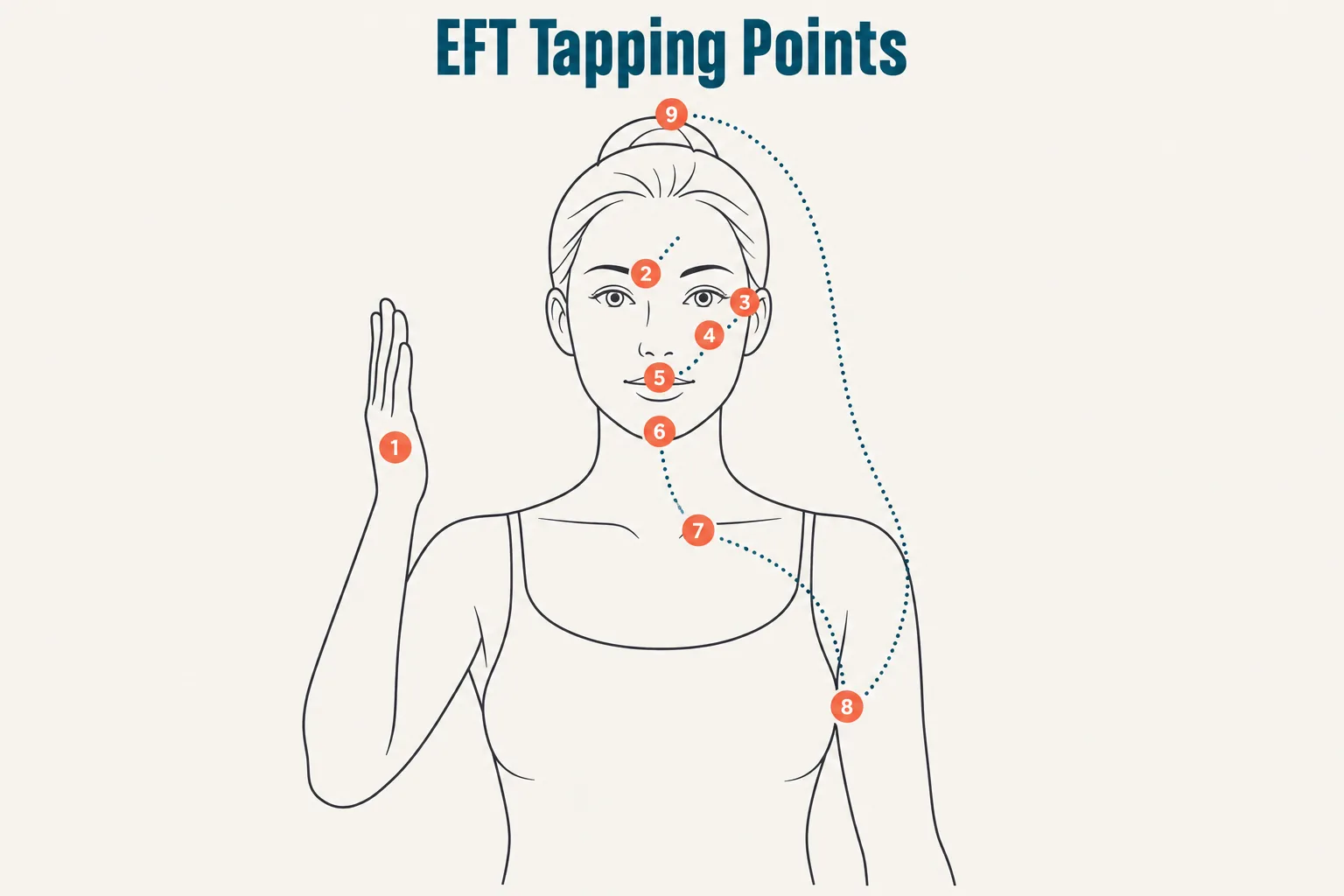
EFT stands for Emotional Freedom Techniques, and most people just call it tapping. Its point sequence draws on acupressure practices. That history does not establish an energy-based explanation for emotional eating or prove why a tapping exercise might help.
A basic round looks like this:
-
Name the feeling. For example: “I’m anxious about tomorrow’s meeting, and I want the cookies.”
-
Rate it if helpful. An optional 0–10 intensity rating can describe how you feel; it is not a diagnostic test.
-
Say a setup phrase while tapping the side of your hand. Use words you can say comfortably, such as: “Even though I’m stressed and craving sugar, I can notice how I feel.”
-
Tap through the points (eyebrow, side of the eye, under the eye, under the nose, chin, collarbone, under the arm, top of the head) while repeating a short reminder phrase like “this craving.”
-
Re-rate if useful. Notice how you feel and choose whether to continue or stop. You do not need to reach zero.
A brief round may fit into an ordinary day, but you do not need to keep tapping if it hurts or increases distress. If you practice in a car, do so only when safely parked. Do not use tapping to postpone food you need.
Hunger and emotion can occur together. A craving does not prove that you are avoiding a feeling. For a comparison with a talk-based approach, read EFT vs CBT for eating.
What Is EMDR Therapy?
EMDR stands for Eye Movement Desensitization and Reprocessing. It is a trauma-focused psychotherapy that includes assessment, preparation, and work with distressing memories. Its goal is to reduce the distress connected with those memories, rather than erase what happened.
The VA’s EMDR overview describes the preparation, memory work, and follow-up involved. The standard protocol has eight phases, from history-taking and preparation through processing, closure, and reevaluation. Eight phases do not mean eight sessions, and an appointment may focus on preparation rather than processing a memory.
For PTSD care, work with a licensed clinician trained in EMDR. Following a moving dot or copying alternating taps does not reproduce the full therapy. Theories about how EMDR changes memory processing are still being studied.
EMDR Tapping vs Eye Movements vs EFT Tapping
Here’s where people get tangled up, because EMDR can involve tapping too.
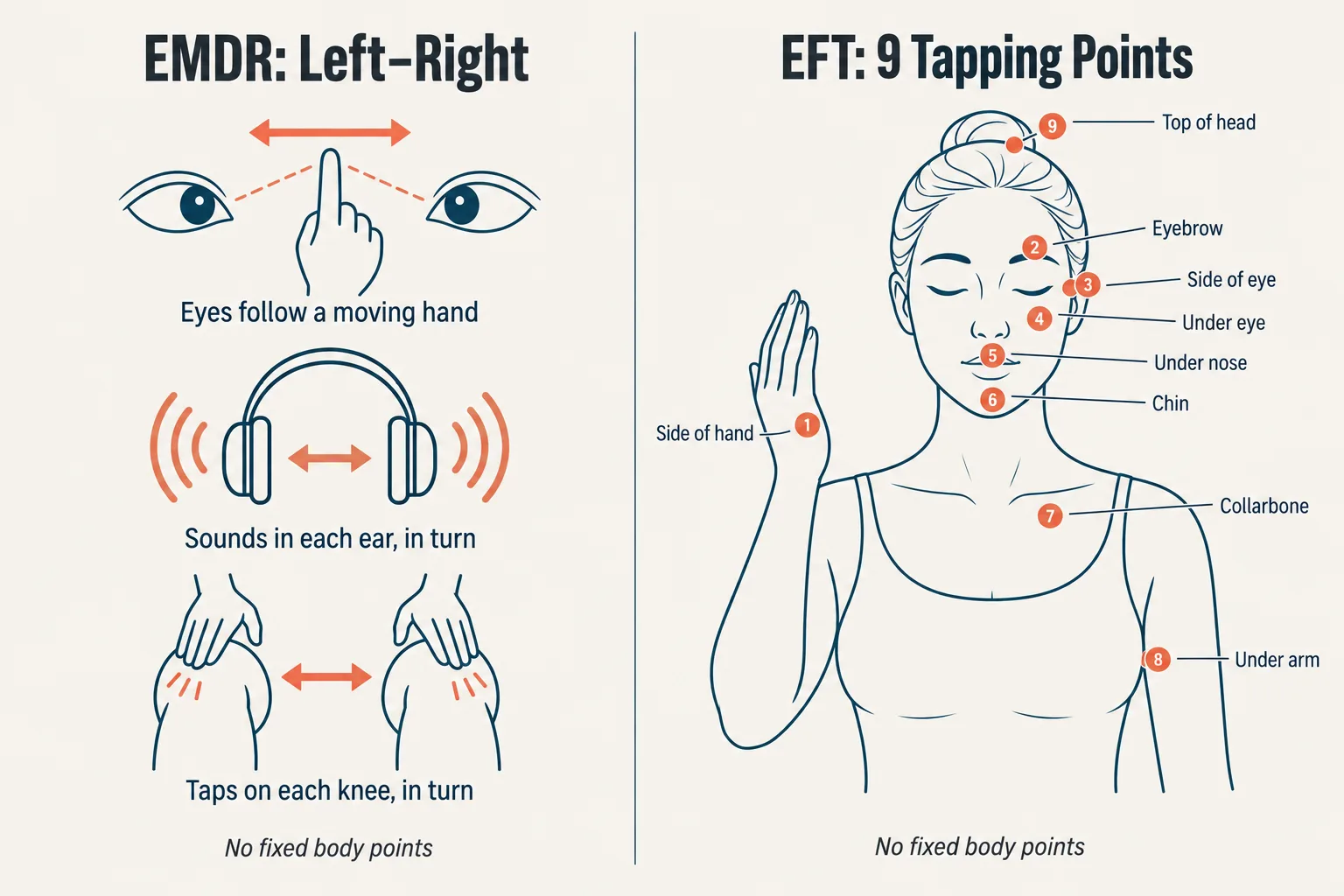
The left-right rhythm in EMDR is called bilateral stimulation (“bilateral” just means both sides). It can take a few forms:
-
Eye movements: following a hand or light from side to side
-
Sounds: alternating tones in each ear through headphones
-
Taps: alternating touch on the body, guided by the clinician
These are different ways of delivering bilateral stimulation. That does not establish that every version works equally well for every person or purpose. Ask your clinician why a particular method is being used and what to do if it feels uncomfortable.
EFT tapping works differently. The taps follow a set sequence of points on the face and body, and the goal isn’t to alternate left and right. Same verb, different tools.
Side-by-Side: How EFT and EMDR Differ
| Feature | EFT tapping | EMDR therapy |
| What you do | Tap body points while focusing on a feeling, thought, or concern | Work with memories within a structured process that may use bilateral stimulation |
| Who provides it | Self-use, a coach, or a practitioner; check their qualifications and scope | A licensed mental health professional with EMDR training for clinical care |
| Structure | Tapping rounds; guided approaches vary | An eight-phase protocol tailored to the person’s needs |
| Use at home | A self-help option when appropriate; stop if it increases distress | Follow the clinician’s plan; self-tapping alone is not the full therapy |
| Typical focus | Distress, cravings and other concerns; evidence varies by outcome | Trauma-related difficulties, with established guideline support for PTSD |
| Time | A round is not the same as a guided appointment or program | A course of therapy; phases and sessions are different units |
| Setting | A private, suitable place or a guided appointment | Clinical appointments in person or by telehealth, where appropriate |
Both approaches can involve paying attention to feelings and physical sensations. That overlap does not show that they work in the same way or have the same evidence. Feeling calmer during an exercise is also different from a lasting change in eating or PTSD symptoms.
Which Is More Effective, EMDR or EFT?
For PTSD, EMDR has stronger guideline support. For emotional eating, the evidence discussed here does not establish that either approach is the best choice for you.
The VA’s PTSD treatment overview, summarizing the 2023 VA/DoD guideline, identifies EMDR as a recommended trauma-focused therapy. It lists Emotional Freedom Techniques among approaches with insufficient evidence to recommend for or against their use for PTSD. This is a statement about the evidence, not proof that nobody benefits from EFT.
A small 2011 comparison trial randomized 46 people with PTSD to EMDR or EFT. Both groups improved, with similar effect sizes and a somewhat higher proportion showing substantial clinical change in the EMDR group. That small study does not establish equal effectiveness or tell us which approach works better for emotional eating.
In a separate food-cravings trial, 83 adults with overweight or obesity received EFT or cognitive behavioral therapy over eight weeks. Both groups improved on craving measures, but BMI did not decrease. EMDR was not part of that comparison. Craving scores, weight change, and recovery from an eating disorder are different outcomes.
My EFT research overview offers related reading. For a treatment decision, discuss the evidence for your specific concern with a qualified clinician rather than relying on testimonials or a general claim that one method goes deeper.
Why Do Some Therapists Have Reservations About EMDR?
A clinician may suggest a different approach based on your assessment, preferences, or their training. Preparation and a plan for managing distress are useful topics to discuss. There is also scientific debate about EMDR’s mechanisms, which does not remove its guideline support for PTSD.
Ask why EMDR is being recommended, what alternatives are available, and how you will review progress. You can raise concerns without dismissing a treatment that may fit your needs.
Trauma vs Everyday Food Stress: Where Each Fits
Emotional eating does not tell you whether you have trauma or PTSD. A clinician’s assessment is more useful than dividing concerns into “serious trauma” and “ordinary stress” based on how dramatic an experience sounds.
For a professional woman over 45, a demanding career, caregiving, and repeated dieting may all be part of the picture. An evening urge could involve exhaustion, a wish for comfort, hunger, or several needs at once. These are examples to consider, not assumptions about every client.
In my coaching, we can explore whether eating has become a familiar way to feel soothed or protected. This perspective can make room for self-compassion. It does not prove that every food struggle comes from a subconscious protective pattern.
-
With EFT, a self-help exercise might focus on a current feeling such as “I’m exhausted and want something sweet.” You can notice your response without searching for a traumatic memory.
-
With EMDR, a trained clinician assesses which memories and symptoms to address within a treatment plan. It can involve more than one event; it is not limited to a single dramatic memory.
For example, arriving home at 9 pm after a tense day and a missed meal may call for food as well as rest. A recurring traumatic memory may call for clinical support. Neither example lets an article diagnose you or select your treatment.
When to Choose a Licensed Mental Health Professional
Please seek clinical assessment rather than relying on coaching if you are experiencing:
-
Diagnosed or suspected PTSD
-
Flashbacks or intrusive memories that take over your day
-
Feeling detached from your body or surroundings
-
Feeling unsafe, or having thoughts of harming yourself
-
An active eating disorder, repeated loss of control around eating, severe restriction, or purging
These signs are reasons to seek help, not a self-diagnosis checklist or an automatic recommendation for EMDR. A clinician can discuss suitable care, which may include EMDR or another approach. If you cannot keep yourself safe, seek urgent local help.
Coaching and EFT are not a substitute for mental health treatment. My role is coaching, not psychotherapy, diagnosis, or medical treatment. You can read more in my website disclaimer.
Can EFT and EMDR Work Together?
Ask your EMDR clinician before adding EFT between appointments. Using both does not establish that the combination is more effective, and a self-help exercise should not change or replace your treatment plan.
Discuss what you would practice, when you should stop, and whom to contact if distress increases. Tell both providers about the support you are receiving so their roles are clear.
One more acronym mix-up: EFT can also mean Emotionally Focused Therapy, often associated with couples work, or Emotion-Focused Therapy. Those are different psychotherapy approaches. In this article, EFT means Emotional Freedom Techniques tapping.
Why Your Food Struggle May Involve More Than Food
If you’ve been through the weight-loss world, you’ve heard it all. Eat less. Move more. Try this shake, this app, this 30-day reset. It worked for a while, until it didn’t.
A difficult relationship with food does not make you undisciplined. Exploring feelings, beliefs, and coping habits can be useful, while regular nourishment and health needs still deserve attention. Food is not irrelevant, and an article cannot identify one root cause for everyone.
My coaching focuses on the emotional patterns around eating. EFT is one tool I use in that work. The aim is a calmer relationship with food and your body; it is not a promise of permanent change, weight loss, or trauma treatment.
FAQ: EFT vs EMDR
Is it okay to cry during EFT tapping?
Yes, you can pause if you cry or feel upset. Tears, yawning, or a sigh do not prove that trauma is releasing or that the exercise is working. You do not need to keep tapping through distress. Stop if you feel overwhelmed and seek support if it persists.
Can I do EFT on my own?
You can learn EFT as a self-help exercise, but whether it suits you depends on your circumstances. Do not use it to work through traumatic memories alone or replace care you need. Pause if it increases distress, and discuss persistent symptoms with a licensed mental health professional.
Does tapping help with weight loss?
Tapping is not an established way to guarantee weight loss. The food-cravings trial described above found improved craving measures without a reduction in BMI. A change in stress or cravings does not establish that weight will change, and it does not replace assessment of eating or medical concerns.
Are there times tapping should be avoided?
Tapping shouldn’t replace clinical trauma care. If a round brings up distress you can’t manage on your own, stop and get professional support. Also stop if the tapping itself hurts. A method being described as natural does not make it suitable in every situation.
Can I do EFT if I’m already doing EMDR?
Check with your therapist first. They should be in the loop on anything you use between sessions. Agree on a plan for whether and how to use EFT, including when to pause. Do not assume that adding another technique will improve EMDR’s results.
Choosing Support for a Calmer Relationship With Food
The EFT vs EMDR choice starts with the concern you want help with. For PTSD or symptoms that disrupt your life, seek assessment by a licensed clinician. If you are exploring the feelings and habits around eating, ask what a provider offers, what their qualifications cover, and how progress will be reviewed.
If the 9 pm pantry example feels familiar, you deserve support without blame or a promised cure. My private coaching focuses on exploring emotional patterns around food. Explore one-to-one coaching with me to see whether the approach fits your needs and the care you already receive.