


EFT tapping for sleep is a self-help exercise that pairs light tapping with words about what you are feeling. Research on sleep is still limited, and the routine below is not a proven treatment for insomnia. You can try it briefly during your wind-down if it feels comfortable, without making sleep or a lower stress score a target you must reach.
Why You’re Exhausted but Still Wide Awake at 11 PM
You ran the meeting, answered the late emails, checked the homework, and finally got into bed. Your body is done. Your mind is not. It’s replaying a conversation from this afternoon, drafting tomorrow’s to-do list, and circling back to a worry you thought you’d put away years ago.
Stress can make winding down difficult, but it is not the only explanation for poor sleep. In midlife, night sweats, changes in routine, medicines, and other health concerns may also deserve attention. Being awake does not prove that your body feels unsafe or that a hidden belief is keeping you alert.
This is an optional bedtime exercise, not an insomnia treatment or a test of how well you can relax. If sleep problems keep returning or affect your day, seek healthcare advice rather than relying on a longer tapping session.
What EFT Tapping Is (in Plain Terms) and Can It Help With Sleep?
EFT stands for Emotional Freedom Techniques, though most people just call it tapping. You lightly tap a short series of points on your face and upper body with your fingertips while you say, out loud or silently, what you’re feeling.
Naming a worry may give you something specific to notice during the exercise. You do not need to assume that tapping sends a safety signal to your body or changes a particular hormone to try it.
Sleep findings need careful interpretation. A 2025 postmenopausal sleep trial assigned 58 women to EFT or a control group. After four weeks, the authors reported improvements in some aspects of sleep, but not a significant improvement in overall sleep quality on the main sleep questionnaire. That does not establish that this short bedtime script will help you fall asleep.
My work with women on their relationship with food spans more than 20 years. My background includes professional cooking, nutrition, and EFT. This routine is offered as a self-help example; my coaching is not a sleep clinic or a substitute for medical care.
The 9 EFT Tapping Points You’ll Use Tonight
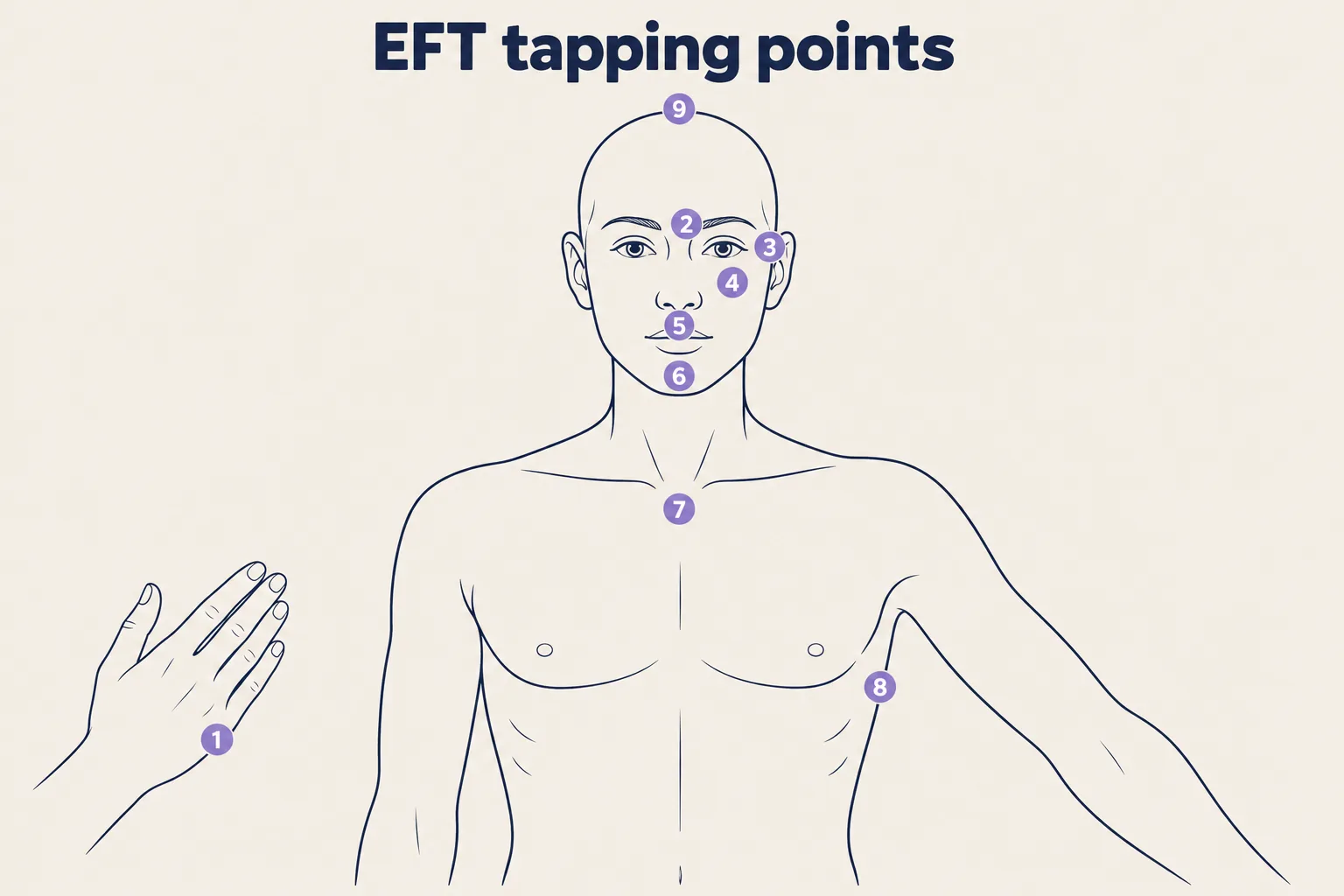
These are the nine commonly taught points, counting the side of the hand used for the setup. My step-by-step tapping guide explains the sequence in more detail.
-
Side of the hand (karate chop): the fleshy outer edge below the little finger.
-
Inner eyebrow: where the eyebrow begins, near the bridge of the nose.
-
Side of the eye: on the bone at the outer corner of your eye.
-
Under the eye: on the bone below the eye, not on the eyeball.
-
Under the nose: the small space between your nose and upper lip.
-
Chin: the crease midway between your lower lip and the point of your chin.
-
Collarbone: just below where your collarbone meets your breastbone.
-
Under the arm: on the side of the upper torso, below the armpit.
-
Top of the head: the crown.
How to tap: use clean fingertips and a light, comfortable touch. A few taps at each point are enough to follow the example; the number is not a sleep prescription. Do not press on your eyes or continue at a painful point.
For bedtime: you can try the exercise while seated during your wind-down. Keep lighting low and stop when you feel sleepy. If you have a treatment plan for insomnia, follow it rather than adding a prolonged activity in bed.
Face-only version: you can skip points that are awkward or uncomfortable and use just the comfortable facial points. This is a shortened exercise, not a version shown to have the same sleep effects as a full sequence. You can also stop altogether.
A Bedtime Tapping Routine for a Racing Mind (Step by Step)
Keep this routine brief and use words that fit your experience. You do not need to complete both rounds, repeat a phrase a set number of times, or feel a particular change.
Step 1: Name What’s Keeping You Up and Rate It if Helpful
Pick one manageable, present-day concern: the email you did not answer, tomorrow’s meeting, or tension in your shoulders. You can describe it in a few words. An optional 0–10 intensity rating can help you notice how you feel, but it is not a diagnosis or a number you need to lower before resting.
Do not use bedtime as a time to search for traumatic memories. If a thought feels overwhelming, stop and seek appropriate support.
Step 2: The Setup Statement on the Side of the Hand
Tap lightly on the side of your hand while saying a phrase you can use comfortably. You can try one of these, change the words, or leave the words out:
-
“Even though my mind won’t stop racing, I accept myself and how I feel.”
-
“Even though I’m already worried about tomorrow, I’m allowed to rest tonight.”
-
“Even though I’m frustrated that I can’t fall asleep, I can notice how I feel.”
There is no need to force acceptance or tell yourself that you are safe if that does not feel true. The purpose is to name your current experience without adding pressure.
Step 3: Tapping Rounds With a Sleep Script
Round one: name what’s here. Tap lightly through the points while using any phrases that fit:
-
Eyebrow: “All this stuff in my head.”
-
Side of eye: “I can’t switch it off.”
-
Under eye: “So much left undone.”
-
Under nose: “I’m tired of being tired.”
-
Chin: “My body is still on duty.”
-
Collarbone: “Still trying to keep everything handled.”
-
Under arm: “All this worry.”
-
Top of head: “It’s all still here.”
Round two: make room for rest. Continue only if you want to:
-
Eyebrow: “Maybe I can put it down for tonight.”
-
Side of eye: “It will still be there tomorrow.”
-
Under eye: “I don’t have to solve it now.”
-
Under nose: “I did enough today.”
-
Chin: “I can soften my hands.”
-
Collarbone: “Noticing the support beneath me.”
-
Under arm: “Letting my shoulders drop.”
-
Top of head: “Permission to rest.”
Treat this EFT for sleep script as a starting point. Use your own words if they fit better, and skip a phrase that adds discomfort. A script does not need to uncover a deeper cause to be something you try.
Step 4: Check In, Then Stop or Rest
Pause and notice whether you feel calmer, unchanged, or more uncomfortable. You can stop in any of those situations. There is no need to keep going until your score is below three or to work through an unexpected memory alone.
When you feel drowsy, stop. If you remain awake and frustrated, getting out of bed for a quiet activity and returning when sleepy may be more useful than repeating rounds in bed. NHLBI’s insomnia treatment guidance explains this approach and identifies cognitive behavioral therapy for insomnia, or CBT-I, as a usual first treatment for long-term insomnia.
Common Mistakes With Tapping for Sleep
-
Making relaxation another task to pass. You do not have to feel calm, say positive words, or finish every point.
-
Tapping through discomfort. Use a light touch and stop if tapping hurts or brings up distress.
-
Getting pulled into the screen. Read the script beforehand, print it, or use audio with the screen off if that is helpful. Avoid turning a short exercise into scrolling in bed.
-
Treating a week of practice as a required trial. No particular number of nights is established for this routine. You can stop if it feels unhelpful.
-
Relying on tapping for every 3 AM waking. Repeated waking deserves a look at sleep, health, and daily habits, not simply more rounds.
Why a Bad Night May Show Up in Your Cravings the Next Day
Short sleep can affect hunger and interest in food, but it does not explain every craving. In a small sleep-curtailment study, 24 women aged 18–55 reported more hunger and cravings and ate more chocolate after a shortened night than after a normal night. The study does not predict every woman’s response or show that tapping changes it.
For more context, read about sleep and sugar cravings. Consider whether you have eaten enough during the day as well as how you slept and what was happening around the urge.
If you also find yourself eating at night after restricting, the eating pattern deserves attention in its own right. Repeated loss of control, severe restriction, or purging calls for clinical assessment. Sleep, hunger, and emotional needs can overlap without sharing one hidden root cause.
Tapping for Sleep and Anxiety: When the Worry Runs Deeper
Recurring worries do not prove that a protective subconscious pattern is causing your sleep problem. If worry or poor sleep interferes with daily life, discuss it with a healthcare professional or licensed mental health professional.
Midlife symptoms also deserve care. Stanford Lifestyle Medicine’s perimenopause and sleep overview describes how hot flashes, night sweats, and mood changes may affect sleep and why persistent problems should not be dismissed as inevitable aging. A tapping routine does not replace assessment or treatment for those concerns.
In my coaching, we can explore feelings, habits, and beliefs around eating, including whether food has become a familiar source of comfort. That is one perspective to explore, not a diagnosis of why you are awake. My guided-session overview explains the coaching process and when clinical care is needed.
Other Quick Sleep Tricks People Ask About
How do Navy SEALs fall asleep so quickly?
Treat a promise of falling asleep in two minutes cautiously. Relaxing the face, jaw, and shoulders and breathing comfortably are simple relaxation ideas; this article does not establish a Navy SEAL protocol or a guaranteed way to fall asleep. You can choose a quiet wind-down without adding another performance target.
Where is the pressure point to induce sleep?
A pressure point is not a guaranteed sleep switch. EFT uses light tapping at several points, while acupressure is a different practice. Do not assume that pressing a wrist point reproduces EFT or treats insomnia. Choose comfort over deep pressure, and stop if it hurts.
What is the Japanese trick to sleep fast?
That label does not identify one clearly described, tested treatment. Look at what the actual exercise involves and what evidence supports it. A simple, consistent wind-down can be easier to assess than a promise of instant sleep.
FAQ
How long should I tap before bed?
Keep it brief if you choose to try it. A few minutes can be a practical choice, but there is no established dose for this bedtime script. Stop when you feel sleepy, uncomfortable, or ready to move on; you do not need to finish five or ten minutes.
Can I tap lying down in bed?
You can choose a comfortable position, but avoid making prolonged tapping another activity you do while lying awake. Trying it earlier while seated may fit a wind-down better. Follow your clinician’s advice if you are receiving insomnia treatment, and do not assume a face-only version has proven sleep benefits.
What if I wake up at 3 AM?
You do not have to start tapping. Keep stimulation low and avoid clock-checking or scrolling. If a brief exercise feels helpful, you can try it; if you remain awake and frustrated, use a quiet activity outside bed and return when sleepy. Seek advice if waking keeps recurring.
Can EFT tapping help with weight loss too?
I can’t promise any weight outcome. This sleep routine has not been shown to cause weight loss. My coaching explores feelings and patterns around eating, but improved sleep or a change in how stressed you feel does not guarantee a weight change.
When should I see a doctor about sleep?
Seek advice if poor sleep persists or affects your daytime life. Loud snoring, breathing pauses, waking gasping, or marked daytime sleepiness also deserve assessment. Mention mood changes, medicines, and midlife symptoms. You do not need to wait until you have tried tapping for a set number of nights.
A Calmer Next Step for Sleep and Food Concerns
EFT tapping for sleep can be something to try during your wind-down, with no score or finishing line to reach. Keep the exercise comfortable and let yourself stop. If sleepless nights keep returning, seek care for the sleep problem rather than assuming you need to work harder on a script.
If you would like support exploring the feelings and habits around eating, explore one-to-one coaching with me and see whether the approach fits your needs. The aim is a calmer relationship with food and your body, alongside the healthcare and sleep support that may also help.


