

You can run a department. You can run a household. You can hold a budget together and remember everyone else’s appointments without writing them down.
Then it hits 9 pm, the house finally goes quiet, and you are standing at the open fridge with no memory of deciding to walk there.
Short answer: CBT has an established role in treating binge-eating disorder, while the evidence for EFT tapping and food cravings is smaller. In one randomized comparison, 83 adults with overweight or obesity received EFT tapping or CBT for eight weeks. Both groups improved on craving measures, but neither showed a reduction in BMI. That study cannot tell us which approach will work best for every woman with emotional eating, or whether either will lead to weight loss.
Stress can play a part in an evening craving. So can hunger after a long day, sleep, medication, health concerns, or familiar habits. You deserve support that looks at your own circumstances instead of assuming there is one explanation for every craving.
I have spent more than two decades helping women understand their relationship with food. Here is how CBT and the EFT tapping I use differ, what we know so far, and when a licensed clinician is the right person to call.
What Does EFT Mean in This Comparison?
Here, EFT means Emotional Freedom Techniques, also called EFT tapping. It involves gently tapping points on the face and upper body while paying attention to a feeling, thought, or craving.
Two other approaches share those initials: Emotion-Focused Therapy is a psychotherapy centered on emotional experience, and Emotionally Focused Therapy is commonly used in couples work. That second name is why a search about EFT can bring up comparisons with the Gottman Method. This article compares EFT tapping with CBT for emotional eating.
How CBT Addresses Emotional Eating
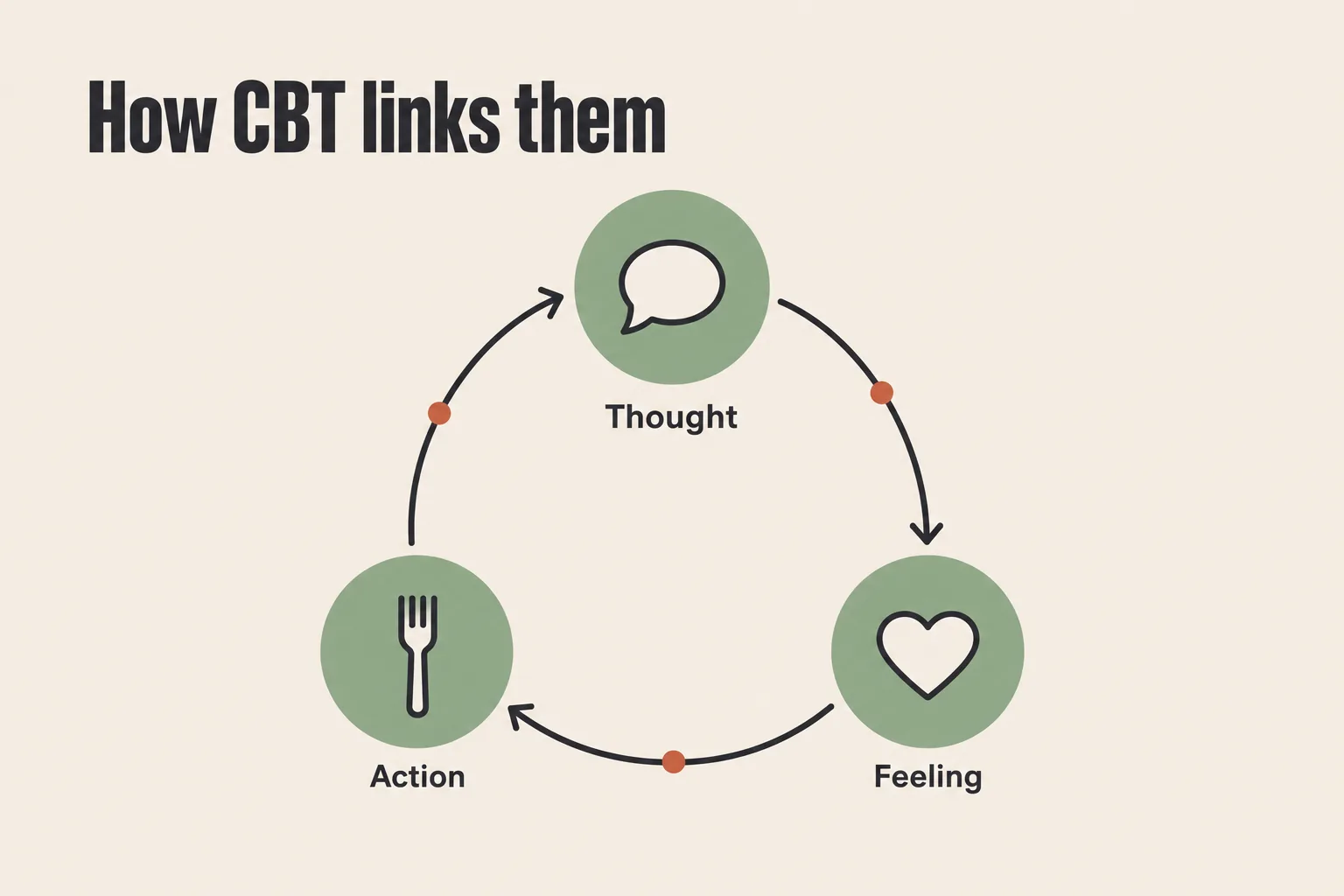
Cognitive behavioral therapy, or CBT, examines connections among thoughts, feelings, and actions. For eating difficulties, a therapist can also help you look at eating patterns and practice skills between sessions.
Depending on your needs, that may include:
- Noticing when eating feels hard. A food and mood record, if appropriate for you, can help identify circumstances that precede an urge.
- Eating more regularly. A plan for meals and snacks can help if going too long without food is part of the pattern.
- Working with rigid rules. A therapist may help you respond differently to a thought such as “I ate one thing I hadn’t planned, so the day is ruined.”
- Planning for difficult moments. You can practice responses to stress, challenging feelings, and situations where an old habit tends to return.
CBT can be helpful when you want structured support or when eating feels out of control. For diagnosed binge-eating disorder, the American Psychiatric Association identifies individual or group CBT as an effective treatment. That clinical recommendation does not mean that everyone who eats for comfort has an eating disorder.
How EFT Tapping Is Used for Food Cravings
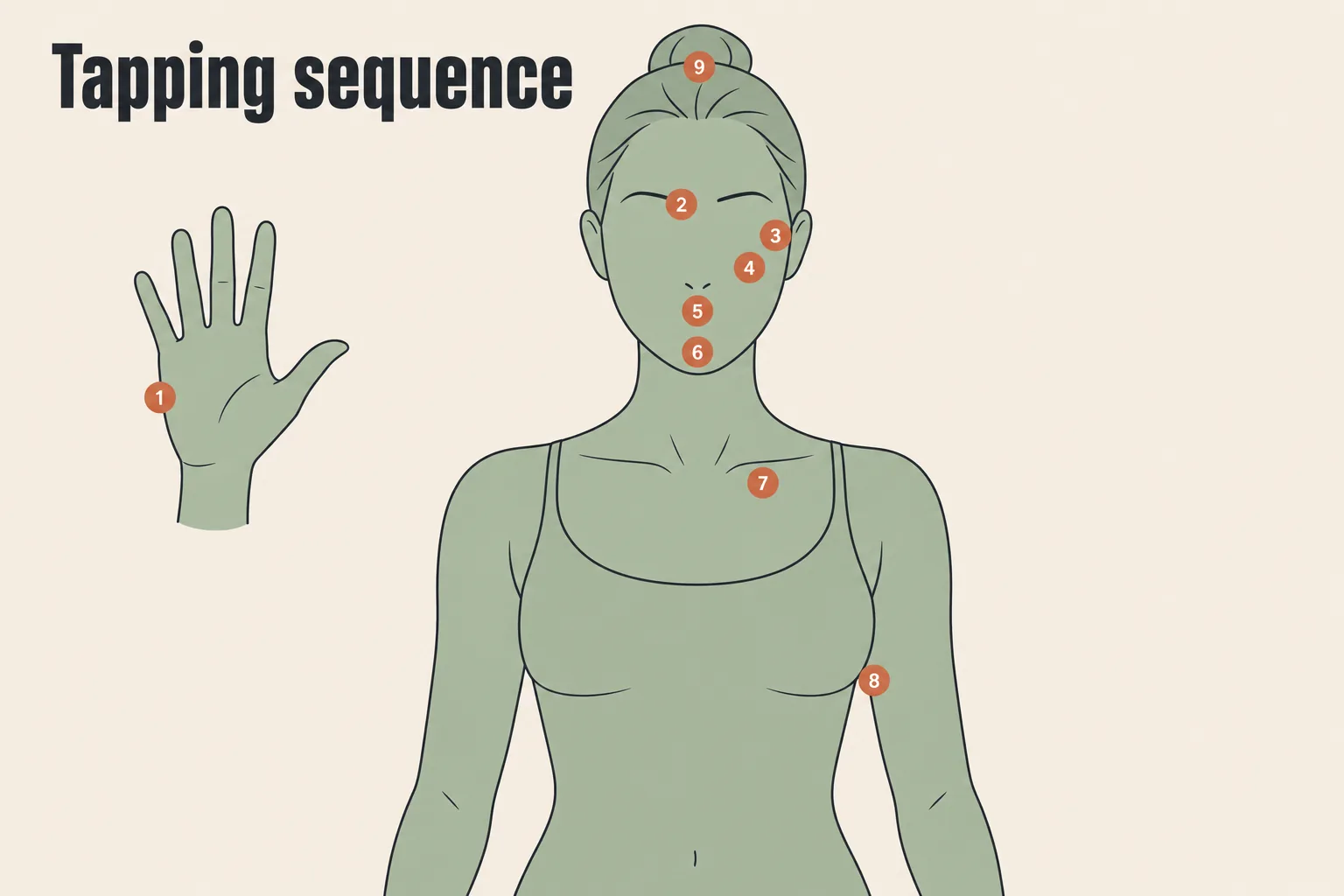
With EFT tapping, you pay attention to an urge or a feeling while gently tapping a sequence of points. In my coaching, I may ask what is happening right before a craving and whether stress, a belief about yourself, or another concern seems relevant. Some women find it useful to notice how intense an urge feels before and after a round. The response varies from person to person.
What a Tapping Session Involves
You might start by naming what is happening now: “I want something sweet, and I feel wound up.” Then you tap through the points, pause, and notice whether anything has shifted. A chart can show you the sequence; my EFT tapping-points guide explains it step by step. My guide to EFT for emotional eating goes further into applying the practice to food.
You do not have to assume that a craving traces back to a particular memory. The food-cravings comparison study cannot establish whether tapping points, focused attention, the words used, or a combination produced its results.
Related readingEFT for Binge Eating: When Food Isn’t the Real ProblemRead the guide →A round of tapping is a tool to explore; it is not a test you have failed if an urge does not change.
EFT Tapping vs CBT: Approach, Evidence, and Limits
| Question | CBT | EFT tapping |
|---|---|---|
| What might you do? | Work with a therapist on thoughts, feelings, eating patterns, and practical coping skills. | Focus on a feeling or craving while tapping, on your own or with a practitioner. |
| What is the evidence closest to this topic? | A substantial treatment literature for binge-eating disorder and research on emotional-eating interventions. | A smaller food-cravings literature, including one direct comparison with CBT. |
| Can it treat a diagnosed eating disorder on its own? | CBT is an established clinical treatment when delivered by an appropriately qualified professional. | The food-cravings study does not establish tapping as a substitute for eating-disorder treatment. |
| Will it cause weight loss? | No particular weight outcome is guaranteed. | No particular weight outcome is guaranteed; the direct comparison found no BMI reduction in either group. |
This is a comparison of what the approaches involve and what has been studied. Your symptoms, preferences, and any existing care matter more than a label on a chart.
Is EFT More Effective Than CBT? What the Research Actually Says
In the 2016 food-cravings trial mentioned above, EFT tapping and CBT showed comparable improvements in cravings, responsiveness to food in the environment, and dietary restraint. Participants were assessed after treatment and at six and twelve months. “Comparable” within one study does not prove that the approaches are equally effective for all emotional eating, for binge-eating disorder, or for my one-to-one coaching.
A 2023 systematic review of emotional-eating interventions for adults with overweight or obesity described CBT as showing the most promise within its analysis. The weight estimate for its CBT subgroup came from only three studies and was uncertain; it was not a head-to-head finding about EFT tapping. A 2025 research update examined a larger set of emotional-eating studies and behavior-change techniques. It did not establish that tapping outperforms CBT.
For diagnosed binge-eating disorder, CBT has a stronger established clinical role. For food cravings, the direct tapping-versus-CBT study offers a reason to keep researching both approaches, with realistic expectations about weight. If you want a broader discussion of tapping research and its limitations, read what the evidence on EFT tapping shows.
A 9 P.M. Example: What Might Each Approach Do?
Suppose you reach for food after a demanding day. First, it is reasonable to ask whether you are hungry; perhaps lunch was rushed, or dinner was too small. If you also feel tense, a CBT therapist might help you notice what happened before the urge, make your eating pattern more reliable, and practice ways to respond to the stress. An EFT practitioner might invite you to notice the present urge and tap while you name what you feel, then check whether its intensity changes.
Those are examples of possible work, not promises about what will happen in a session. Hunger, stress, and habits can overlap. You do not need to settle on a single “root cause” before asking for help.
How to Choose Support, and When to Seek Clinical Care
- Consider CBT with a qualified therapist if you want a structured approach to eating patterns, thoughts, and feelings, or if a clinician recommends treatment for an eating disorder.
- Consider EFT tapping as a complementary option if you want to explore how you respond to cravings or stress. Ask a practitioner what they do, what training they have, and when they refer someone for clinical care.
- If you have already tried one approach and still struggle, reassess the pattern with an appropriate professional. Previous treatment not helping enough does not prove that you need a specific different method.
When Coaching Is Not Enough
Recurring episodes of eating with a sense of losing control, purging, severe restriction, or significant distress deserve assessment by a licensed health or mental-health professional. The National Institute of Mental Health’s guide to eating disorders describes signs that warrant attention. If you are receiving eating-disorder treatment, tell your clinician about any complementary practice you want to use. Coaching does not diagnose or replace that care.
CBT for binge-eating disorder may include work on triggers, feelings, body image, and regular eating. The NHS treatment guide also advises against dieting during treatment because restriction can make it harder to stop binge eating.
How Sandy Uses EFT in One-to-One Coaching
Many of the women over 40 who come to me have learned a lot about nutrition and still feel stuck around food. In our one-to-one coaching, we look at the circumstances around their cravings, including stress, habits, and beliefs that may be relevant. I use EFT tapping as one tool while we work toward a calmer relationship with food and your body.
When you describe a craving as “self-sabotage,” we can explore what happens around it without assuming your behavior has just one cause.
There is no fixed timetable for a change in cravings, and I cannot promise a weight result or say that tapping treats a medical or psychological condition. If your eating raises a clinical concern, the next step is an assessment with an appropriately qualified professional.
Frequently asked questions
Can EFT tapping be used alongside CBT?
Has EFT tapping been compared directly with CBT for food cravings?
Are EFT tapping and Emotion-Focused Therapy the same?
Does CBT address emotions, or only thoughts?
Does either approach guarantee weight loss?
When should I seek an eating-disorder assessment rather than coaching alone?
Explore One-to-One Coaching With Sandy
If your main struggle is persistent cravings and stress around food, and you want to see whether my approach fits, explore my one-to-one coaching and apply. We can talk about what you are experiencing and whether this kind of support makes sense for you.