

If you’ve been quietly wondering why is losing weight so hard after 40, you’re not the only one sitting with that question. Most women don’t say it out loud at first. They just notice something’s off. The same effort doesn’t give the same result. The body feels different. Less responsive. Almost like it has its own agenda. And it’s frustrating, because logically, nothing major has changed. This is especially true when it comes to weight loss for women over 40.
In this guide, we’re going to slow things down and look at what’s actually going on, both physically and beneath the surface, because the real answer isn’t as simple as eat less or move more. It never really was.
Why Is Losing Weight So Hard After 40?
Why is losing weight so hard after 40, even when you’re doing what you’ve always been told should work? Because at this point, your body is no longer responding to surface-level strategies alone.
It’s responding to history. To stress. To accumulate patterns. To hormones that don’t behave the way they used to. And honestly, two years of trying to fix something that was never just about food in the first place. That’s the part that tends to get missed.
What worked at 25 was built for a different body. A different nervous system. A different life stage. Trying to apply those same rules now, it doesn’t just fail. It creates confusion. And eventually, self-doubt.
The Real Biological Changes That Affect Weight After 40
Before anything else, it’s worth acknowledging something clearly. Your body has changed. Not in a negative way. But in a way that requires a different kind of understanding. These changes are subtle at first. Then they’re not.
Slower metabolism and muscle loss (Sarcopenia)
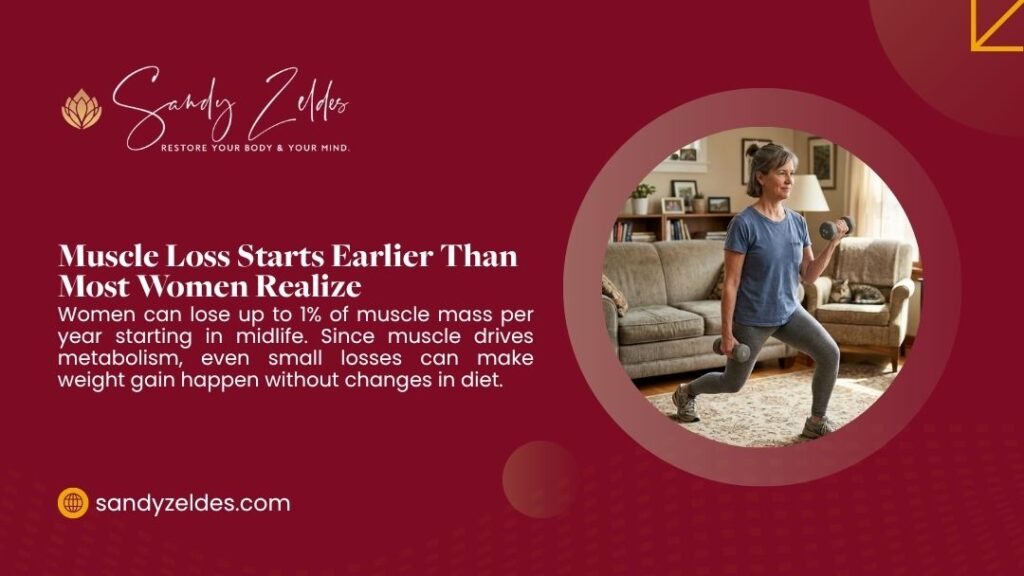
Muscle naturally declines with age unless it’s actively maintained. And since muscle is metabolically active tissue, losing it means your body burns fewer calories throughout the day, without you doing anything differently. So you can eat the same way you always have and still gain weight. That’s not imagined. That’s physiology. According to research from the National Institutes of Health, metabolic rate declines with age, largely due to muscle loss and changes in activity levels.
Hormonal shifts (Perimenopause/Menopause) and fat storage
Hormonal shifts play a major role in weight after 40, especially in women. Estrogen begins to fluctuate during perimenopause and menopause, and eventually declines. That shift alone changes how your body stores fat. Instead of distributing weight more evenly, it starts favoring the midsection, particularly around the abdomen. Studies show that the hormonal changes of menopause tend to make it more likely that women will gain weight around the abdomen, rather than the hips and thighs. That’s why belly fat becomes more noticeable, even for women who never struggled with it before.
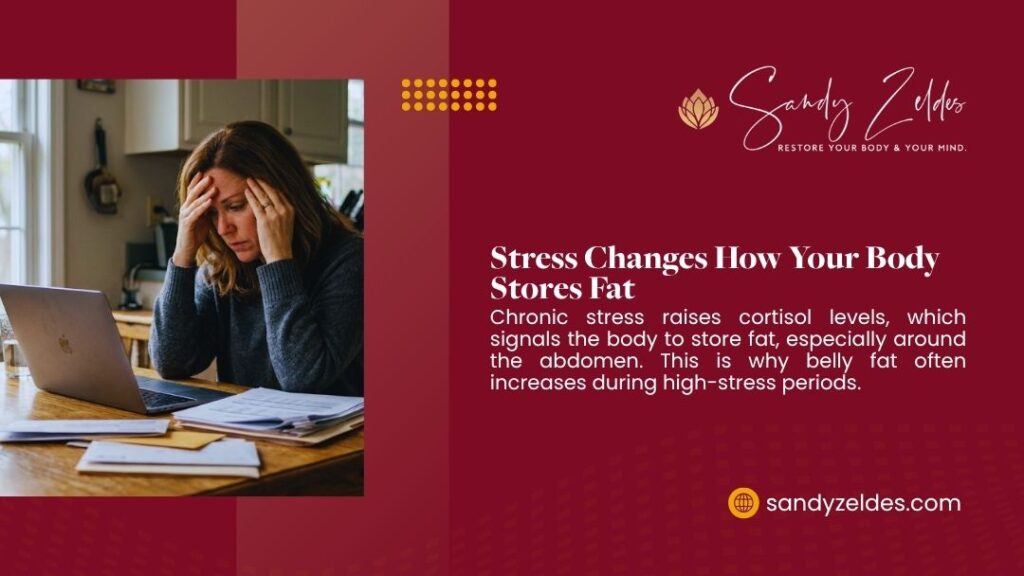
Cortisol, the stress hormone, also becomes more influential. Chronic stress raises cortisol levels, which signal your body to hold onto fat, especially stubborn belly fat.
Insulin resistance and blood sugar shifts
Something else begins to change quietly in the background: how your body handles sugar. As estrogen levels drop, your cells don’t respond to insulin the way they used to. This means glucose stays in the bloodstream longer instead of being used efficiently for energy. Over time, the body compensates by storing more of that excess energy as fat. And not just anywhere.
It tends to settle around the abdomen. That’s why many women notice that even small changes in eating habits can lead to weight gain that feels disproportionate. It’s not about eating too much. It’s about how your body is processing what you eat now compared to before.
Appetite hormone disruption
Hunger and fullness cues don’t always stay reliable after 40 in women. Leptin, the hormone that signals fullness, and ghrelin, the one that triggers hunger, can become less balanced, especially when sleep is inconsistent or stress is high. So you might feel hungry when your body doesn’t actually need fuel. Or you may not feel satisfied even after eating. This can create a loop that feels confusing.
You eat, but it doesn’t quite hit the mark. Then later, the craving returns. Not because you lack control, but because the internal signals that guide appetite have shifted.
Sleep changes and metabolic impact
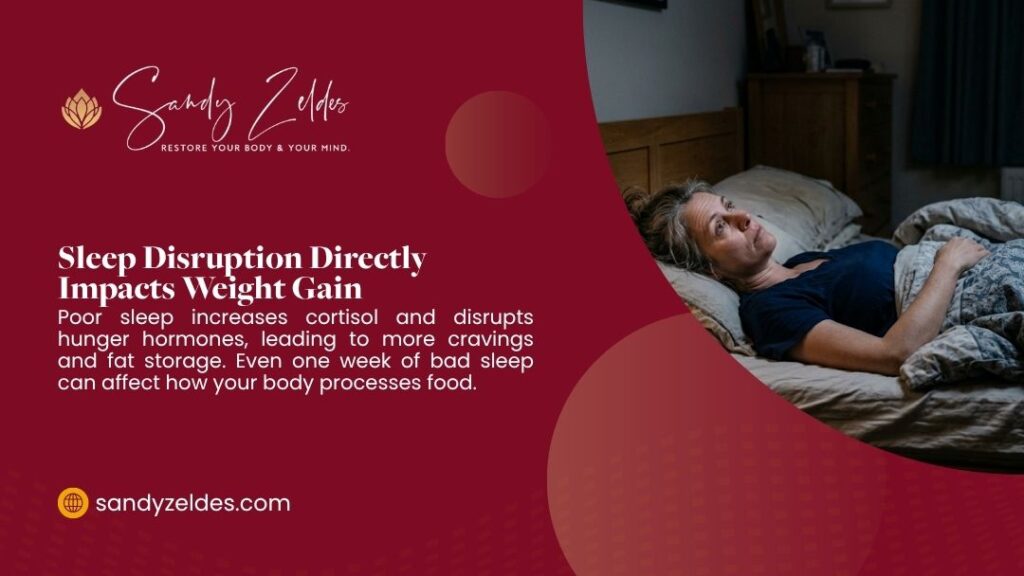
Sleep often becomes lighter, shorter, or more interrupted during midlife. And while that might seem unrelated to weight, it has a direct effect.
When sleep quality drops, the body produces more cortisol and less of the hormones that regulate metabolism. This combination can increase food cravings, reduce energy, and make the body more likely to store fat. It also affects decision-making.
When you’re tired, your brain looks for quick energy. That usually means sugar or refined carbs. Not out of habit, but out of survival.
Increased visceral fat storage
There’s also a change in where fat is stored, not just how much. Before 40, fat distribution is often more balanced. After hormonal shifts begin, the body starts storing fat deeper in the abdominal cavity. This is known as visceral fat. It’s less about what you see and more about what’s happening internally.
Visceral fat surrounds organs and is influenced more by hormones and stress than by calorie intake alone. That’s one of the reasons why losing weight after 40 feels different; it’s not just surface-level fat anymore.
Thyroid function changes
For some women, thyroid function can slow down slightly with age. Even subtle changes in thyroid hormones can affect how efficiently the body uses energy.
This doesn’t always show up as a clear medical condition, but it can influence how easily weight is gained or lost. You might notice it as feeling colder, more fatigued, or simply less responsive to the same habits that once worked.
Reduced energy expenditure in daily life
Another shift doesn’t get talked about much. Daily movement tends to decrease, not because of laziness, but because life changes. More sitting, more responsibilities, less spontaneous activity.
This lowers what’s known as non-exercise activity thermogenesis (NEAT), which plays a bigger role in calorie burn than most people realize. So even if workouts stay the same, overall movement may not, and that affects weight over time.
Key biological changes after 40
There isn’t just one factor. It’s a combination that builds over time.
| Change | What it does | Why it matters |
| Estrogen decline | Alters fat storage patterns | More abdominal fat |
| Insulin sensitivity drops | Blood sugar regulation weakens | Easier fat gain |
| Metabolic rate slows | Fewer calories are burned daily | Weight gain without overeating |
| Muscle mass decreases | Less energy is burned at rest | Harder to lose weight |
| Hunger hormones shift | Appetite signals become less reliable | More cravings |
| Cortisol rises more easily | Stress response intensifies | Fat storage increases |
According to the clinical studies, these overlapping shifts are a primary reason weight becomes harder to manage during midlife.
Why You Can’t Lose Weight Even When You’re Doing Everything Right
This is the part that tends to feel the most discouraging. Because effort is there. Discipline is there. Awareness is there. And yet, progress isn’t.
Chronic stress and emotional eating
Stress isn’t just mental. It’s biochemical. When your body perceives stress, whether it’s from work, relationships, or even internal pressure, it releases cortisol. And cortisol doesn’t just make you feel tense. It directly influences fat storage and cravings, especially for sugar and high-fat foods. So when you find yourself reaching for something sweet or comforting, it’s not random. It’s a response.
If you’ve noticed yourself eating when stressed, even when you’re not hungry, there’s often a deeper pattern behind it. Understanding why we eat when we’re not hungry can help uncover emotional triggers, habitual responses, and the connection between stress and cravings.
Subconscious self-sabotage
This is where things get a little quieter and more important. You can want something consciously and still move in the opposite direction without realizing it. That doesn’t mean you lack discipline. It means patterns are running in the background. Patterns built over the years.
If you’ve ever thought, Why do I sabotage my weight loss every time? You’re not alone in that experience. There’s a reason it happens, and it’s not because you’re failing.
Your body is trying to protect you
This part is often misunderstood. What looks like resistance is often protection. Your body is wired to keep you safe. And sometimes, the habits you’re trying to change are actually serving a purpose, reducing stress, creating comfort, and maintaining familiarity. Until that layer is acknowledged, change feels temporary. Or inconsistent.
The Truth About Dieting After 40 (Why It Often Backfires)
Most women have tried dieting. Multiple times. And at some point, they notice something strange, it works less each time. That’s not a lack of effort. That’s adaptation.
When you restrict food, your body doesn’t just comply. It compensates. It slows metabolism. It increases hunger signals. It becomes more efficient at storing fat. This explains why many women experience weight gain despite eating less.
This is why rigid approaches often stop working after 40. They don’t take into account what your body is trying to maintain. This is why so many women feel like they’re starting over again and again. The strategy keeps changing, but the underlying pattern doesn’t. Until that pattern is addressed, the outcome tends to repeat, just with more frustration each time.
Why Belly Fat After 40 Is So Hard to Lose
Belly fat has a reputation, and for good reason. It behaves differently. Belly fat after 40 is strongly influenced by hormonal shifts and chronic stress. When estrogen drops, and cortisol rises, the body shifts toward storing fat in the abdominal area. This isn’t about appearance, it’s about internal regulation.
You can strengthen your core. You can do abdominal work. But fat loss doesn’t happen in isolation. The body doesn’t choose where to lose fat based on exercise alone. Fat loss requires a broader approach that includes metabolism, hormones, and lifestyle factors.
What makes belly fat stubborn
Stubborn belly fat isn’t just about appearance; it’s tied to bigger metabolic changes. Visceral fat, which surrounds internal organs, becomes more common with age. This is why losing belly fat after 40 feels different. It’s not just extra weight; it’s hormonally driven fat storage that resists traditional dieting methods.
| Factor | Effect |
| Elevated cortisol | Encourages fat storage |
| Hormonal imbalance | Shifts fat to the midsection |
| Insulin resistance | Makes fat harder to burn |
| Sleep disruption | Slows metabolic function |
What Actually Works for Weight Loss After 40
At this point, it becomes less about pushing harder and more about working differently.
Strength training and muscle support: Rebuilding muscle changes how your body uses energy. It doesn’t just help with fat loss; it supports overall metabolic health. It’s one of the most effective ways to maintain or lose weight after 40.
Nutrition that works with your body: Instead of restriction, the focus shifts toward balance. Meals that stabilize blood sugar tend to reduce cravings naturally.
Stress regulation changes everything: This is often underestimated. Lowering stress doesn’t just improve how you feel; it changes how your body stores and releases fat.
Addressing the deeper cause: For many women, the real shift happens when they stop focusing only on food. This is also where most approaches fall apart. They focus on what you should do: eat less, move more, but never address what’s actually driving the behavior underneath. That’s why the results don’t last.
Sandy’s approach works differently because it doesn’t start with food. It starts with the patterns behind it, stress responses, emotional triggers, and subconscious habits that quietly run the show. When those are addressed directly, the need for willpower drops, and change stops feeling like a constant fight. That’s why it works when other methods don’t.
Patterns. Triggers. Emotional responses. That’s where approaches like EFT for emotional eating, including learning how to do EFT tapping in a simple, practical way that helps interrupt those patterns in real time, begin to make sense, not as a quick fix, but as a way to interrupt cycles that keep repeating.
| Approach | Outcome |
| Dieting | Temporary results |
| Strength training | Metabolic support |
| Stress reduction | Hormonal balance |
| Root-cause work | Lasting change |
How to Jumpstart Weight Loss After 40
Weight loss after 40 doesn’t require extreme changes. It requires the right focus. If things feel stuck, it usually means something needs to shift, not intensify. Start where most people don’t look first. Sleep. Stress. Rhythm. When those stabilize, everything else tends to follow more naturally.
According to Harvard Health, aging is associated with an increase in fat mass and a decrease in lean muscle mass, which contributes to a slower metabolism. Harvard also notes that starting in middle age, people lose about 1% of muscle mass per year, which affects how many calories the body burns. That single shift explains a lot of what women experience without being told why.
Common Mistakes That Keep You Stuck
Sometimes the issue isn’t what you’re not doing, it’s what keeps repeating.
| Pattern | Outcome |
| Constant dieting | Metabolic slowdown |
| Ignoring stress | Ongoing fat storage |
| Over-reliance on willpower | Inconsistency |
| Focusing only on food | Missing root cause |
Noticing these patterns tends to change how you approach things moving forward.
The Missing Piece Most Women Over 40 Never Address
There’s a layer most strategies don’t touch. The nervous system. If your body is constantly in a state of tension or alertness, it won’t prioritize change. It prioritizes safety.
| Missing factor | Effect |
| Nervous system stress | Resistance to weight loss |
| Emotional triggers | Recurring cravings |
| Habit loops | Repetition of patterns |
| Lack of internal safety | Slower progress |
When this shifts, everything else tends to become easier to sustain.
FAQs
What is the hardest age to lose weight?
Honestly, it’s not one exact age, but a lot of women start feeling it somewhere in their 40s. It kind of creeps up. Things that used to feel simple suddenly don’t work the same way. You might still be eating pretty much the same, moving the same, and yet your body responds differently.
That’s usually when hormones start shifting more noticeably, and the body becomes a bit less forgiving. Not broken. Just different.
What is the 3-3-3 rule for losing weight?
You’ve probably seen this floating around: three meals, spaced out, balanced plates. It can help some people feel more structured, especially if they’ve been grazing all day or skipping meals. But it’s not really some magic formula.
If someone is dealing with cravings, stress eating, or that feeling of “I know what to do, but I don’t do it,” a rule like that doesn’t really touch the root of it.
What slows metabolism after 40?
It’s not just one switch flipping. It’s more like a few small things stacking up over time. Muscle gradually drops if it’s not maintained. Hormones shift. Stress sticks around longer than it used to. Sleep isn’t always as solid. Individually, none of those seems huge. Together, they change how your body uses energy.
What’s the worst carb for belly fat?
The obvious ones tend to be the most problematic: sugary foods, processed snacks, and things made with refined flour. They digest quickly, don’t keep you full, and often lead to that cycle where you’re hungry again not long after.
But here’s the thing, it’s not just the carb. The state your body is in, stressed, tired, or regulated, changes how it handles those foods.
Which body part loses fat first?
People often notice their face or upper body changing first. The lower belly tends to hang on a bit longer, especially after 40. That’s why it can feel like nothing’s happening, even when your body actually is changing, just not where you expected.
What is the #1 worst food for weight gain?
There isn’t really one single food that causes weight gain all by itself. But highly processed foods tend to create the most issues over time. They’re easy to overeat, don’t satisfy for long, and can lead to more cravings later on. Still, most of the time, it’s not about one food. It’s about patterns that quietly repeat.
How to Finally Lose Weight After 40 Without Starting Over Again
So, why is losing weight so hard after 40? Because most approaches only address the surface. Once you begin to understand what’s happening underneath, physically and emotionally, things stop feeling random. Or frustrating. Or impossible.
And if you’re ready to explore a different way of approaching this, one that actually looks at the root of the issue, you can learn more about her approach or see how others have shifted their relationship with food and their body over time.
Sometimes, the change isn’t about doing more. It’s about finally doing what works. If you feel ready, you can always reach out for support.