

Food noise can make a smart, capable woman feel as if food has the final say. She may eat a healthy breakfast, promise herself a calmer day, and still end up thinking about snacks, sugar, dinner, tomorrow’s diet, or the thing she “shouldn’t” want. For many women over 40, that mental chatter is not just about appetite. It can be tied to stress, blood sugar, hormones, sleep, old diet wounds, and the part of the mind that still reaches for food as safety.
Natural GLP-1 for ending out of control cravings and food noise is not about chasing a “natural Ozempic” trend or trying to copy medication at home. It is about understanding how the body’s hunger signals, gut hormones, nervous system, and subconscious self-protection can work together to keep cravings loud.
This article explains what natural GLP-1 support can and cannot do, and why lasting peace with food often starts below the surface of cravings.
Disclaimer: This article is for education only and is not medical advice. If you have type 2 diabetes, take blood sugar medication, have a history of an eating disorder, are pregnant, or are considering GLP-1 medication, speak with a licensed healthcare professional.
Natural GLP-1 for Ending Out of Control Cravings and Food Noise
GLP-1 stands for glucagon-like peptide-1. It is a gut hormone your body releases after you eat. It helps with appetite, blood sugar control, fullness, and the speed at which food leaves the stomach. That is why GLP-1 is often discussed in conversations about food intake, cravings, and weight management.
Prescription GLP-1 medications, such as semaglutide, are different. They are GLP-1 receptor agonists, which means they act on the same receptor system as the body’s natural GLP-1. The FDA prescribing information for Ozempic states that Ozempic is a GLP-1 receptor agonist used for adults with type 2 diabetes and that semaglutide delays gastric emptying.
That matters because many people search for a natural alternative to Ozempic, foods that mimic Ozempic, or a homemade Ozempic recipe, and expect a single food, drink, or supplement to do what medication does. That is not how the body works. Food and lifestyle can support natural GLP-1 levels, but they do not become semaglutide, Wegovy, or Mounjaro.
Still, natural GLP-1 for ending out of control cravings and food noise can be a useful frame when it is handled honestly. Protein, fiber, healthy fats, movement, sleep, and lower stress may help the body feel more satisfied. But for many women over 40, the hardest cravings are not only physical hunger. They show up when stress peaks, when the day finally gets quiet, when old shame gets stirred, or when the body feels unsafe after years of dieting.
That is where Sandy Zeldes’ work fits. Sandy’s holistic approach to weight loss is built around the idea that food is often the visible symptom, not the deepest cause.
What Food Noise Really Means When You Are Not Physically Hungry
Food noise is the mental chatter about food that does not seem to switch off. It can sound like planning, bargaining, craving, guilt, or constant checking. You may think about what you ate, what you should not eat, what you will eat later, or how to make up for it tomorrow.
A little thought about food is normal. The problem starts when those thoughts feel sticky, loud, and hard to ignore.
“If your food thoughts are causing you distress or getting in the way of you living your life, that’s when they become food noise.” — Viviane Fornasaro-Donahue, PhD, RDN, LDN, quoted by Harvard Health.
That definition matters because it takes shame out of the picture. Food noise is not the same as being weak. It may involve blood sugar swings, under-eating, poor sleep, stress, learned eating behaviors, emotional pain, or the brain’s reward system. For some women, it also carries old memories of restriction, criticism, trauma, or years of trying to shrink the body to feel acceptable.
This is why “just eat more protein” can help one person but barely touch the real issue for another. If the craving is driven by hunger, a balanced meal can help. If the craving is driven by a nervous system that wants comfort, safety, or relief, food advice alone can feel thin.
Why GLP-1 Medications Quiet Food Noise So Well
GLP-1 medications have become so popular partly because they can reduce hunger and lower the mental pressure around food. People often describe it as if someone turned down the volume in their mind.
The science makes sense. GLP-1 is tied to satiety, gastric emptying, insulin response, appetite signals, and the brain’s reward system. Research on GLP-1 analogues has found that they may decrease food intake and reduce weight by suppressing appetite, reducing hunger, and increasing fullness.
That does not mean GLP-1 medications are right for everyone. They may be appropriate for people with type 2 diabetes, obesity, or specific medical needs under the care of a licensed clinician. They can also come with side effects, cost concerns, and long-term questions. More importantly, they do not automatically resolve every emotional pattern linked with food.
A woman may feel less hungry on medication and still feel unsure how to trust herself around food long-term. Another may stop medication and notice that old cravings return. Cleveland Clinic notes that the reduction in cravings from semaglutide is temporary and that cravings are likely to return if the medication stops, which is why lifestyle changes still matter.
The STEP 1 trial extension also found that participants regained a mean of two-thirds of their prior weight loss one year after withdrawal of once-weekly semaglutide 2.4 mg and lifestyle intervention. That does not mean medication failed. It means appetite, weight regulation, habits, stress, and identity often need long-term support rather than a short burst of control.
This is not a criticism of medication. It is a reminder that biology, habits, stress, and emotional safety all need a seat at the table.
Can You Increase GLP-1 Naturally Without Ozempic?
Yes, the body’s own GLP-1 response can be supported through food and lifestyle. No, that does not mean there is a homemade Ozempic or an OTC semaglutide equivalent.
Ohio State Health reports that meal composition and meal order can influence GLP-1, especially when protein or healthy fats are eaten with dietary fiber before carbohydrates. The same source notes that vegetables before carbohydrates may help post-meal blood sugar by increasing insulin secretion and slowing stomach emptying.
A review on nutritional modulation of endogenous GLP-1 secretion found that manipulating diet composition may stimulate the body’s own GLP-1 secretion, which may be relevant for obesity and type 2 diabetes management.
The practical takeaway is simple. Natural GLP-1 for ending out of control cravings and food noise begins with steadier meals, enough food, calmer eating, and less punishment around hunger. When the body is fed in a way that supports fullness and blood sugar, the mind often gets quieter.
| Natural GLP-1 Support | How It May Help | Best Examples | What It Will Not Fix Alone |
| Protein at meals | Helps you feel full longer and supports steadier appetite | Eggs, Greek yogurt, fish, chicken, tofu, lentils, cottage cheese | Emotional eating rooted in stress or shame |
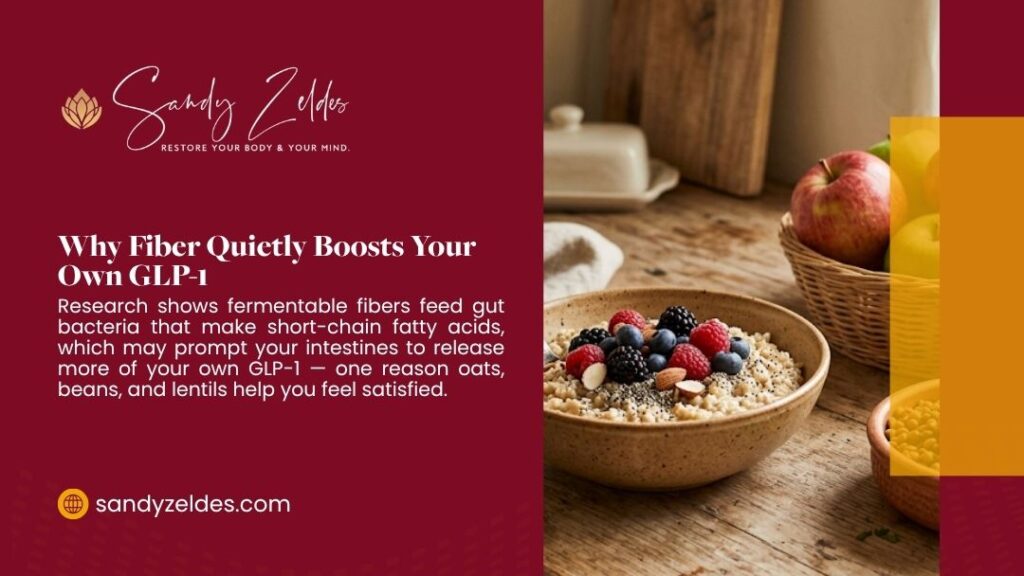
| Soluble and fermentable fiber | Supports gut hormones and slower digestion | Oats, beans, chia, flax, apples, vegetables, legumes | Night eating caused by exhaustion or anxiety |
| Healthy fats | Can add satiety and slow the meal down | Olive oil, avocado, nuts, seeds, salmon | Subconscious self-sabotage patterns |
| Meal order | May reduce glucose spikes and support fullness | Vegetables or protein before fast carbs | Restriction-binge cycles from dieting |
| Sleep and stress care | Helps regulate hunger hormones, cravings, and impulse control | Consistent sleep, deep breathing, EFT, boundaries | Past trauma or long-term emotional protection patterns |
Protein, Fiber, and Healthy Fats Help Your Body Feel Full
Most natural Ozempic guides talk about protein and fiber for a reason. They help reduce the physical panic that can show up when blood sugar drops or meals are too light. A breakfast of coffee and willpower may look disciplined at 9 a.m., but by 8 p.m. the body often wants payback.
A better meal pattern does not have to feel rigid. It can be as ordinary as eggs with vegetables, lentil soup with olive oil, Greek yogurt with berries and chia, salmon with roasted vegetables, or tofu with greens and avocado. The point is not perfection. The point is to give the body enough substance so it does not have to scream later.
For women over 40, this becomes even more important. Hormonal shifts, poor sleep, stress load, and long diet history can make the body less forgiving of skipped meals and low-protein days. Sandy goes deeper into this stage of life in her guide to hormone balance and menopause after 40.
Slow Eating and Meal Order Can Matter More Than People Think
Food noise often gets worse when meals are rushed. The body may have eaten, but the brain never got the memo. That is why slow eating matters.
This does not mean chewing each bite for an exact count or turning lunch into a wellness ceremony. It means putting the fork down now and then, noticing taste, starting with protein or vegetables, and giving the body time to register fullness.
Ohio State Health notes that food order can influence GLP-1 stimulation and post-meal blood sugar responses, with protein or fat plus fiber before carbohydrates showing stronger effects than carbohydrates first.
For women who have spent years dieting, slow eating can feel uncomfortable at first. Paying attention may bring up feelings that fast eating used to cover. That is useful information, not failure. Sometimes the meal is not the only thing that needs care.
Sleep and Stress Can Turn Food Noise Up or Down
Food noise rarely happens in a vacuum. It often gets louder after a hard day, a poor night of sleep, a conflict, a deadline, or a moment where a woman feels unseen, resentful, or depleted.
Stress can push the brain toward quick relief. Poor sleep can make high-calorie foods feel harder to resist. Harvard Health notes that stress and exhaustion can make food noise harder to quiet, partly because ongoing stress may raise cortisol, which can increase appetite and stress eating.
That is why natural GLP-1 for ending out of control cravings and food noise cannot be only a food plan. If the nervous system is living in survival mode, cravings may become a nightly release valve. The body may not be asking for more discipline. It may be asking for safety, rest, and a new way to process pressure.
This is also where EFT can help. Sandy’s work with EFT for food cravings focuses on the emotional charge behind cravings instead of treating cravings as a simple appetite problem.

The Part Most Natural Ozempic Articles Miss: Food Noise Is Not Always About Food
Here is the thing. Many women already know what to eat. They know protein helps. They know vegetables help. They know sleep matters. They may have read every food-noise article, tried every tracker, bought every plan, and still ended up standing in the kitchen at night wondering why they cannot stop. That is the missing piece.
Food noise is not always hunger. Sometimes it is a protective pattern. Sometimes it is an old way to numb hurt. Sometimes it is a rebellion against years of restriction. Sometimes it is the one legal comfort a woman allows herself after being strong all day.
Self-sabotage is not stupidity. It is often a protective mechanism. The part of you that reaches for food may be trying to keep you safe, calm, distracted, comforted, or in familiar territory. When you fight that part with shame, the pattern often digs in deeper.
That is why Sandy’s work on subconscious blocks to weight loss fits so naturally. If the root pattern is not addressed, another set of food rules can simply recreate the same cycle in a different form.
Ready to Look Beneath the Craving? If you already know this is not just about food, Sandy’s 3-month one-on-one coaching can help you explore the deeper stress, self-sabotage, and emotional patterns behind out-of-control cravings. Apply to work with Sandy to see whether her private coaching is the right fit.
| Experience | What It May Mean | What Helps Physically | What Helps Emotionally |
| Hunger returns soon after a meal | Meal may lack protein, fiber, fat, or enough total food | Add protein, fiber, healthy fats, and enough calories | Reduce fear of eating enough |
| Sugar cravings hit at night | Blood sugar, fatigue, habit, or emotional relief may be involved | Eat balanced meals earlier and avoid daytime restriction | EFT, stress release, and softer evening routines |
| Food thoughts feel intrusive | Food may be serving as comfort, reward, or control | Stabilize meals and sleep | Address shame, fear, and self-protection |
| Diet starts well, then self-sabotage returns | The plan may feel unsafe to the subconscious mind | Use flexible structure, not strict rules | Explore the part of you that resists change |
| You feel disciplined everywhere except food | Food may be tied to emotional exhaustion or identity | Create practical support around meals | Work with the root cause, not just the behavior |
Why Women Over 40 Can Feel More Out of Control Around Food
Women over 40 often arrive at food noise with a long history behind them. This is not usually their first attempt at change. There may be decades of diets, clean eating, fasting, tracking, detoxes, gym plans, low-carb phases, and “this time I’m serious” Mondays.
Then life gets more complex. Hormones shift. Sleep can become lighter. Stress may pile up from work, aging parents, relationships, children, money, leadership, or the private pressure to keep everyone else okay. The body may not respond the way it did at 28.
This can create a painful misunderstanding. A woman may think, “My body is broken.” In reality, the body may be adapting to years of stress, restriction, and pressure.
For a high-achieving woman, the food struggle may be the one place she cannot outwork, outplan, or outthink the pattern. Sandy addresses this directly in her piece on why some women are disciplined in every area of life except food.
Natural GLP-1 support can calm physical appetite. It can help the body feel steadier. But when the deeper story involves control, safety, shame, or self-worth, the work has to go deeper than the plate.
Natural GLP-1 vs EFT for Food Cravings: What Helps What?
Natural GLP-1 support and EFT do not compete with each other. They solve different parts of the puzzle.
Natural GLP-1 strategies may help the physical side of appetite. A balanced meal can help a woman feel full, reduce blood sugar swings, and lower the kind of hunger that makes cravings feel urgent. This is useful and should not be dismissed.
EFT works on the emotional charge. It can help when a craving is tied to stress, anger, grief, shame, fear, or the belief that food is the only fast way to feel better. Sandy’s tapping for weight loss work speaks to this deeper level. For a look at another popular non-diet method, see Sandy’s guide on intuitive eating versus tapping and where each one fits.
A simple way to tell the difference is to ask what the craving is asking for. If the body is hungry, feed it. If the craving comes with pressure, secrecy, numbness, or panic, pause. Something else may need attention.
That is also why Sandy’s role as an EFT practitioner for weight loss matters. Her audience is not just searching for another meal plan. Many are looking for a method that helps them stop fighting themselves.
How to Stop Food Noise Naturally Without Another Diet
The first step is to stop treating food noise as proof that you need more control. More control often creates more pressure. More pressure often makes cravings louder.
Start by eating enough earlier in the day. An underfed body will keep talking. Then build meals that include protein, fiber, healthy fats, and satisfying foods you actually like. This is basic, but basic works when it is done without punishment.
Next, reduce the all-or-nothing thinking. One cookie does not require a food spiral. One heavy meal does not erase progress. When every choice becomes a moral test, the mind stays trapped in food chatter.
Then look at the emotional pattern. Notice when food noise appears. Is it after conflict? After loneliness? After a perfect day of restriction? After you finally sit down? After you feel you have given everything to everyone else?
If the craving has an emotional charge, EFT can be used before the food choice. Not as another trick to suppress hunger, but as a way to reduce the urgency. For some women, EFT may lower the urgency enough to create a pause, and that pause can make a calmer choice possible.
When Food Noise Comes Back After GLP-1 or Dieting
Many women search for how to stop food noise without Ozempic because they want a natural path. Others search because they tried medication or strict dieting and worry about what happens when the external structure is gone.
That concern is valid. Cleveland Clinic notes that cravings are likely to return after stopping semaglutide, and the STEP 1 trial extension found substantial weight regain after semaglutide withdrawal.
Again, this does not mean medication is bad. It means the deeper pattern still deserves attention.
If a woman uses a GLP-1 medication and finally experiences quiet around food, that can be powerful. It can show her that constant food thoughts are not a personal defect. But if she has spent years using food to soothe fear, loneliness, anger, shame, or exhaustion, appetite reduction alone may not teach her how to care for those feelings.
The same is true for dieting. A diet may create short-term structure. It may even create short-term weight loss. But if it also creates deprivation, fear, and identity pressure, food noise may return stronger.
This is one reason Sandy writes about why past failures with weight loss do not mean you failed. Past attempts can reveal the real pattern. They are not proof that change is impossible.
A Root-Cause Plan for Ending Out of Control Cravings
A root-cause plan does not ignore food. It puts food in the right place. Food matters. Protein matters. Fiber matters. Sleep, blood sugar, movement, and meal timing all matter. But if food noise keeps coming back, the question changes from “What should I eat?” to “What is this pattern doing for me?”
That question can feel strange at first. Most women ask, “How do I stop?” Sandy’s work asks something deeper: “What part of me does this habit protect?”
That shift matters because many addictive cravings are not random. They may protect a woman from grief, pressure, anger, desire, visibility, failure, success, or the fear of becoming someone new. In that light, self-sabotage is not the enemy. It is a signal.
This is where natural GLP-1 for ending out of control cravings and food noise becomes more complete. The physical body gets support through food and lifestyle. The emotional body gets support through EFT, nervous-system care, and subconscious work. The woman stops trying to bully herself into change and starts to understand the pattern from the inside out.
If you often wonder why you sabotage weight loss, the answer may not be lack of motivation. It may be that part of you does not yet feel safe with the change you say you want.
When DIY Tips Are Enough vs When Deeper Support May Help
Some women can reduce food noise with better meals, more rest, fewer diet rules, and consistent stress care. Others need deeper support because the pattern has been part of their life for years.
| Situation | Try This First | Consider Deeper Support When |
| Cravings happen when meals are too small | Add protein, fiber, fat, and enough food earlier in the day | You eat enough but still feel pulled toward food for relief |
| Food noise appears after poor sleep | Protect bedtime and reduce evening stimulation | Sleep improves, but the mental chatter stays intense |
| Sugar cravings follow stress | Use deep breathing, a pause, or EFT before eating | Stress eating feels automatic or secretive |
| You restart diets over and over | Replace strict rules with flexible structure | The same self-sabotage returns every time |
| You feel ashamed around food | Practice non-judgment and repair after overeating | Shame controls your choices or keeps you isolated |
If food feels out of control, the goal is not to shame yourself into another plan. Understanding why food feels out of control can help you understand the pattern without blaming yourself.
FAQs About Natural GLP-1, Food Noise, and Cravings
Why do people feel less hungry on GLP-1 treatments?
People often feel less hungry on GLP-1 treatments because these medications work with appetite signals in the body. They can slow gastric emptying, help people feel full longer, and affect the brain’s reward system around food. That is why some people say food noise feels quieter while taking GLP-1 medications.
Still, appetite is only one layer. For many women over 40, cravings can also come from stress, old diet patterns, poor sleep, hormone shifts, or emotional self-protection. That is why Sandy’s approach looks beyond hunger and asks what the craving may be trying to soothe.
Why can’t I stop eating sugar on semaglutide?
Some people still crave sugar on semaglutide because food noise is not always caused by physical hunger. Semaglutide may reduce appetite, but it does not automatically resolve stress eating, emotional eating, old habits, or the nervous system’s need for quick comfort.
Sugar can become tied to relief, reward, rebellion, or a way to come down after a hard day. If the craving shows up when you feel tired, anxious, lonely, resentful, or overwhelmed, the deeper issue may not be sugar itself. It may be the pattern underneath it.
How do I stop food noise without GLP-1?
To stop food noise without GLP-1, start with the basics your body can actually trust: enough food, steady meals, protein, fiber, healthy fats, sleep, and less all-or-nothing thinking. An underfed body will usually keep asking for food, even if your mind wants control.
After that, look at the emotional timing. Does food noise show up after conflict, exhaustion, boredom, or a day of being “good”? If so, the craving may need more than nutrition. EFT, deep breathing, stress release, and root-cause coaching can help create a pause between the urge and the action.
How can I stop food noise naturally?
You can quiet food noise naturally by supporting both the body and the nervous system. Balanced meals may help stabilize blood sugar and appetite. Slow eating, better sleep, movement, and stress care can also help turn down the volume.
But if food noise feels obsessive, emotional, or hard to interrupt, do not treat it as a willpower problem. Sandy’s view is that self-sabotage often has a protective purpose. Instead of asking, “Why can’t I control myself?” a better question is, “What is this craving trying to help me avoid, feel, or survive?”
Do supplements help stop food noise naturally?
Some supplements may support blood sugar, digestion, or general wellness, but no supplement should be treated like a true Ozempic replacement. Be careful with “natural Ozempic” claims, especially if they promise fast weight loss, appetite shutdown, or effortless control.
A safer approach is to build the foundation first: real meals, enough protein, fiber-rich foods, sleep, stress support, and a calmer relationship with food. If cravings still feel out of control, the missing piece may not be another supplement. It may be the emotional pattern driving the craving.
Peace With Food Starts Beneath the Craving
Natural GLP-1 for ending out of control cravings and food noise can help women understand why fullness, blood sugar, meal quality, stress, and sleep matter. Protein, fiber, healthy fats, calm meals, and steady routines may turn the volume down. For some women, that is enough to feel a meaningful shift.
But if the craving keeps coming back, the deeper question may not be food at all. It may be chronic stress. It may be old trauma. It may be the part of you that learned food was comfort, reward, rebellion, or safety. It may be subconscious self-sabotage trying to protect you from a change that does not yet feel safe.
That is the work Sandy Zeldes is known for. Her 3-month one-on-one coaching is designed for women over 40 and 45 who are tired of diets, tired of food noise, and ready to address the root cause of out-of-control cravings instead of managing symptoms forever.
If you are ready to stop fighting food and start understanding what your cravings are really trying to tell you, apply to work with Sandy and see whether her private coaching is the right fit for you.