

Being disciplined in every area of life except food describes a pattern where high-functioning, capable people manage their work, relationships, and daily responsibilities with real consistency yet feel unable to control their eating.
This article walks through why the pattern happens, how to tell the difference between physical hunger and emotional hunger, why more willpower consistently falls short, and what actually helps when eating still feels like the one area you cannot steady.
I’m Disciplined in Every Area of Life Except Food: What This Really Means
Food feels different from everything else in your life for a reason. In most areas, your effort maps onto results in a predictable way.
With eating, that connection often breaks down, not because you are less capable, but because food has quietly taken on an emotional role that has very little to do with nutrition.
A systematic review published in the British Journal of Psychology, covering more than 21,000 participants across 18 studies, found that nearly 45% of individuals with weight concerns struggle with emotional eating.
The problem is common, it is well-documented, and it almost never has much to do with food itself.
| In other areas of life | Food feels different | What it often signals |
| Performance is consistent | Behavior feels reactive | Food is serving a coping function |
| Setbacks are managed calmly | One slip triggers a full spiral | All-or-nothing thinking at work |
| External accountability helps | Private behavior feels uncontrollable | Shame reinforcing the cycle |
| Discipline feels natural | Control requires constant mental effort | Emotional hunger driving the urge |
The same qualities that make you competent and dependable elsewhere, high standards, perfectionism, an internalized pressure to perform, can intensify this exact pattern.
When every other area of life demands consistent output, food can become the one private space where nothing has to be held together.
Why Food Becomes the One Area That Feels Hard to Control
Food holds a unique position in the brain. It functions as both a survival signal and a built-in comfort system, which means emotional states can activate food urges that have nothing to do with physical hunger.
According to the American Psychological Association, 38% of adults have overeaten or eaten unhealthy foods because of stress within the past month, and nearly half of those do so every single week.
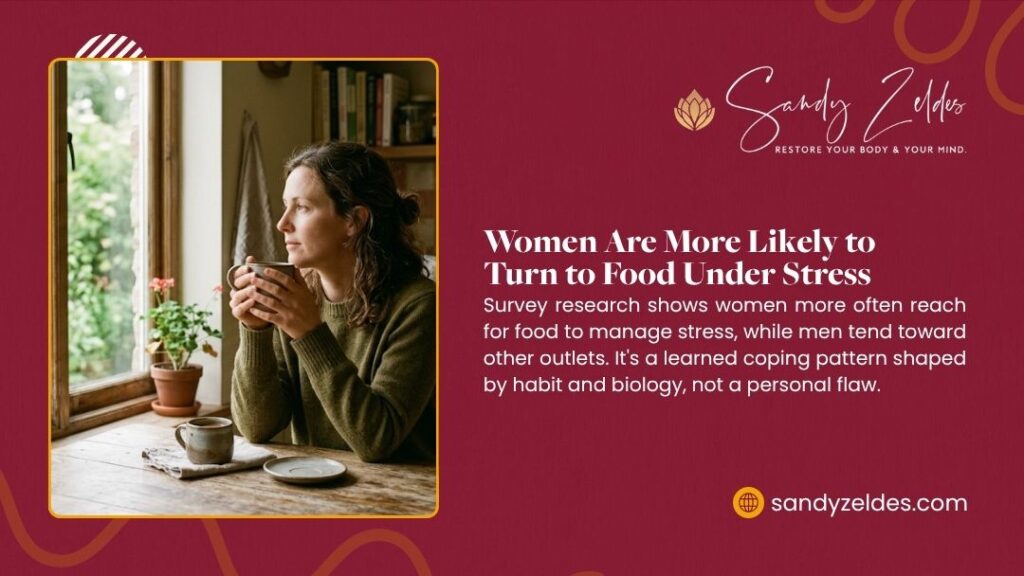
Research also confirms that women are more likely than men to turn to food under stress, while men tend to reach for alcohol or other outlets instead.
If you have noticed yourself feeling out of control around food specifically after a hard conversation, a relentless workday, or an emotional low, this is the mechanism behind it.
| Common trigger | Typical food behavior |
| Stress or sustained pressure | Reaching quickly for high-sugar or high-fat foods |
| Boredom or restlessness | Grazing without real physical hunger |
| Loneliness or disconnection | Eating for comfort or as a form of company |
| Perfectionism and high standards | Restricting through the day, losing control by night |
| Emotional exhaustion | Overeating as the only relief that feels available |
The Stress, Shame, and Reward Loop
When stress arrives, your brain reaches for the fastest available relief. If eating has delivered that relief before, the brain builds an association between food and comfort that strengthens with each use.
Over time, the urge to eat activates automatically whenever tension builds, often before you are even fully aware it is happening.
After eating, guilt tends to follow. That guilt creates its own emotional weight, which then needs managing, and food steps in again.
This loop runs almost entirely below conscious thought, which is why eating when you’re stressed even when you’re not hungry is so difficult to reason your way out of.
Why Perfectionists Often Struggle More Around Food
Research on perfectionism and eating consistently shows that high personal standards, when applied to food, tend to produce rigid rules that eventually snap under pressure. One imperfect meal becomes a justification for abandoning the entire day.
The more controlled everything else feels, the more food tends to become the pressure release. Using food as a reward is one common version of this.
The brain compensates for sustained high performance with something that offers immediate, uncomplicated pleasure. The behavior makes complete sense in context.
Being Disciplined in Every Area of Life Except Food Does Not Make You Broken
If discipline is your default mode in most areas and eating still feels unstable, more self-control is not the answer.
The food behavior is signaling that eating is doing emotional work, and no amount of effort can replace that function until the underlying need is genuinely met some other way.
How to Tell the Difference Between Physical Hunger, Emotional Hunger, and Food Noise
Identifying which type of hunger you are actually dealing with changes everything about how you respond to it.
| Physical Hunger | Emotional Hunger | Food Noise | |
| Onset | Builds gradually | Arrives suddenly | A constant, low-level hum |
| Cues | Stomach signals, low energy | Urgency without body signals | Intrusive, repetitive food thoughts |
| Food preference | Open to a range of foods | Pulls toward specific comfort foods | Preoccupied with particular choices |
| After eating | Satisfied | Guilt or mild regret | Persists even after eating |
| Best response | Eat a nourishing meal | Identify the emotional trigger | Reduce restriction, address stress |
Physical Hunger Signs
Physical hunger builds over time. It shows up as gradual stomach signals, declining energy, or fading concentration. It responds to a variety of foods rather than one specific craving, and it eases naturally once you have eaten enough.
Emotional Hunger Signs
Emotional hunger arrives fast and tends to zero in on particular foods. The urgency feels more like a demand than a gentle signal. Eating may ease the feeling briefly, but the relief is short-lived and guilt often follows close behind.
What Food Noise Feels Like
Food noise has received significant clinical attention in recent years. A 2025 study published in Nutrition and Diabetes formally defined it as persistent, unwanted thoughts about food that create cognitive burden, interfere with daily functioning, and cause genuine emotional distress.
It differs from ordinary cravings and tends to worsen as food rules become more rigid, not less.
When Should I Treat This as a Bigger Issue?
When loss of control around food feels frequent, happens in secret, or leaves you in significant distress afterward, the pattern may need more than self-guided strategies. Recognizing that is not a failure. It is an accurate read of what the situation actually requires.
Why Willpower Alone Keeps Failing With Food
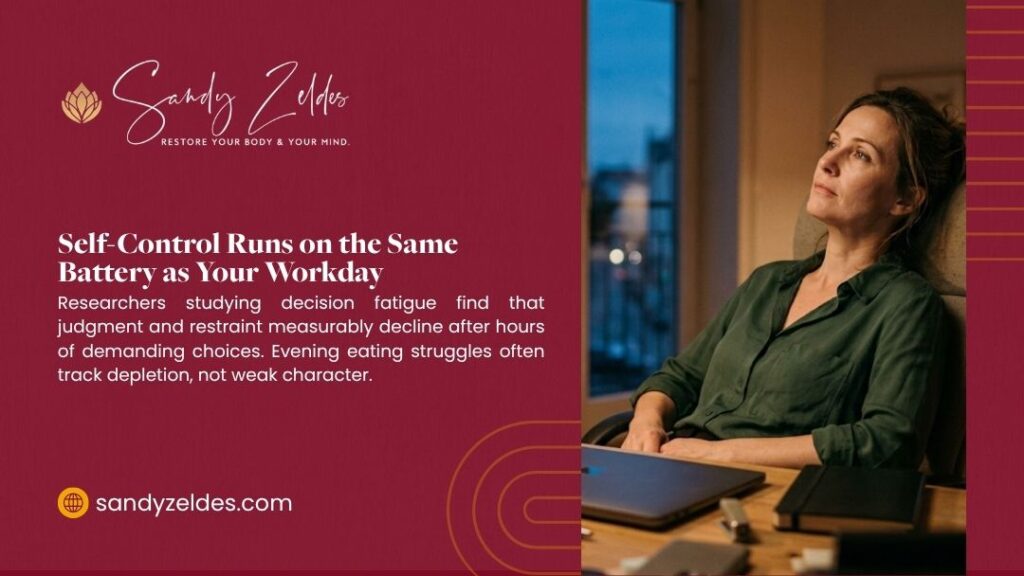
Decision-making and willpower draw from the same mental reserves. Research confirms that by the end of a demanding day, the cognitive resources used for every professional and personal choice throughout your hours are genuinely depleted.
Evening food struggles follow that depletion in a completely predictable way. This is neuroscience, not character.
| Common belief | Why it falls short | A more accurate reframe |
| I need more discipline | Willpower is already spent by evening | The issue is timing and depletion, not character |
| Restricting harder will reduce cravings | Restriction intensifies food preoccupation | Consistent eating reduces urgency over time |
| Guilt will push me to do better | Guilt triggers more eating, not less | Self-compassion breaks the cycle far more effectively |
How Restriction Can Increase Obsession
The evidence on restriction is consistent across studies. Cutting out specific foods tends to make those foods feel more urgent, not less.
Binge eating at night after a day of eating well is often the direct result of a day structured around rigid control. The pressure accumulates across the hours and finds its release by the time evening arrives.
How Fatigue and Decision Overload Affect Eating
Every choice you make across a working day, whether professional, logistical, or relational, draws from the same cognitive pool that food decisions rely on.
By the time you sit down for dinner, the mental capacity available for deliberate choice is genuinely low. That is predictable physiology. It has nothing to do with your strength as a person.
Why Guilt Usually Makes the Cycle Worse
Negative emotion drives eating, eating produces guilt, and guilt produces more emotional distress, completing the loop before you have had a chance to interrupt it.
What to Do Instead When You Feel Out of Control Around Food
The goal is not a stricter plan. It is a calmer, more grounded relationship with eating that does not require constant mental effort to maintain.
| What you feel | What to do now | What to do next |
| A strong craving arriving suddenly | Pause for ten seconds and name the emotion | Walk, journal, or reach out to someone |
| Guilt after eating | Acknowledge it without adding more shame on top | Return to your next meal normally |
| All-or-nothing thinking mid-day | Notice the thought without acting on it | Plan one simple next meal |
| Urge to restrict after a slip | Resist the compensatory impulse | Eat consistently through the next day |
Use a Pause Before Eating
A brief pause between the urge and the action does not suppress the craving. It creates enough space to recognize what is actually happening. That gap is often sufficient to shift an automatic response into something you can consciously choose.
Name the Trigger Without Judging It
Identifying the emotion behind a food urge, whether it is stress, boredom, loneliness, or exhaustion, reduces its intensity. Naming it moves the experience out of the automatic and into something you can respond to rather than simply react to.
Choose One Response That Is Not Food
- A short walk or a change of physical space
- Writing down what you are feeling without editing it
- Reaching out to someone you trust
- Sitting quietly with something warm to drink for a few minutes
These are not substitutes designed to suppress urges. They are real responses to what the urge is actually signaling underneath the craving.
Make the Next Meal Simple, Not Perfect
After a difficult food moment, the most useful thing you can do is return to your next meal without restriction or compensation. One episode does not define the trajectory. What you choose next is where a different pattern actually starts to form.
When to Get Extra Support and What Kind of Help Actually Fits
Some food patterns need more than reading and self-reflection to shift. Knowing when that is the case makes a real difference.
| Symptom | Helpful support type |
| Frequent loss of control that feels impossible to interrupt | Emotional eating coaching or therapy |
| Secretive eating tied to significant shame | Trauma-informed support |
| Food thoughts consuming most of your mental bandwidth | Holistic nutrition and behavioral coaching |
| Pattern tied to anxiety, perfectionism, or low self-worth | EFT or energy psychology |
| Multiple self-guided attempts that have not held | Integrated approach targeting root causes |
Signs the Problem Is Bigger Than Normal Snacking
When episodes are frequent, feel compulsive, happen in secret, and leave you in genuine distress, the pattern has moved beyond what general reading typically reaches.
A persistent history of self-sabotaging your weight loss efforts alongside these food struggles can also point to something operating at a deeper level than behavior alone.
What Kind of Support May Help
Effective support for emotional eating typically combines nutritional stability with emotional processing and a method for reaching the subconscious patterns underneath the surface behavior. One approach rarely handles all of that on its own.
What to Look for in a Good Provider
Look for a provider whose model is rooted in empathy and focused on root causes rather than surface behaviors. If the first solution offered is a stricter food plan, the emotional layer is probably not part of the work.
FAQs
Why am I disciplined in every area of life except food?
Because food has likely taken on a role beyond nutrition. For high-functioning people, eating often becomes the one private coping tool in an otherwise tightly managed life. The issue is not discipline. It is that food is doing emotional work that needs a different kind of support.
Is this emotional eating or just a lack of discipline?
Emotional eating is a behavioral pattern, not a character trait. It describes using food to manage feelings rather than physical hunger. Discipline is not the missing piece. Understanding what is actually driving the behavior is.
Why do I eat when I am not physically hungry?
Your brain has learned that food provides relief. When emotional or physical reserves run low, that learned association activates automatically. It is a coping response, not a moral failing.
Why do I do well all day and overeat at night?
Daytime restriction and accumulated stress both build pressure across the hours. By evening, the body is depleted and reaches for its most reliable source of relief. It is a predictable physiological and emotional response, not a character issue.
How do I stop feeling guilty after eating?
Guilt tends to intensify the pattern rather than reduce it. Returning to your next meal without restriction or shame breaks the cycle more effectively than compensating or punishing yourself. Consistency matters more than perfection here.
What Healing Your Relationship With Food Actually Looks Like
If what you have read here reflects something you have carried for a long time but never had clear language for, that recognition is worth paying attention to.
For over 20 years, I have worked with women who are high-achieving, deeply capable, and genuinely stuck in this pattern. The missing piece was never the food plan. It was the emotional and subconscious layer underneath it that no diet had ever been designed to reach.
My work brings together holistic nutrition, EFT, and energy psychology to address what years of dieting could not.
I offer one-on-one coaching, online courses, and my DailyOM course “Heal Subconscious Blocks to Weight Loss,” which held the number one ranking on the platform for over eight consecutive weeks.
You do not need to have everything figured out before you reach out. Connect with me now and we can explore which approach fits where you are right now.