

Feeling out of control around food means eating past fullness, feeling pulled toward certain foods even when you are not hungry, or finding it nearly impossible to stop once you start.
It is a behavioral and emotional pattern shaped by biology, stress responses, and subconscious habits, not a lack of willpower or personal discipline. Understanding the real drivers behind this feeling is where lasting change begins.
What Does “Out of Control Around Food” Actually Mean?
People describe loss of control in very different ways. Some eat past fullness without noticing until they feel physically uncomfortable. Others feel a strong pull toward specific foods the moment stress arrives.
Some eat quickly, automatically, and only register what happened once the moment has already passed.
| What People Say | What It Often Feels Like | What It Can Signal |
| “I can’t stop once I start” | Urgency, numbness while eating | Restriction rebound or emotional trigger |
| “I think about food constantly” | Mental noise, preoccupation | Undereating, anxiety, or rigid food rules |
| “I eat even when I’m not hungry” | Automatic, emotionally driven eating | Stress response or coping habit |
| “I feel terrible after but keep doing it” | Shame, confusion, guilt | Shame cycle reinforcing the behavior |
| “I’m fine all day but lose it at night” | Relief-seeking after exhaustion | Deprivation or emotional depletion |
The pattern looks different for everyone, but most of these experiences share one thing in common: the behavior is rarely about the food itself.
Why Do I Feel Out of Control Around Food?
Loss of control around food rarely has a single cause. It builds from a combination of biology, emotional state, habit, and learned response.
These factors tend to stack on top of one another over time until eating starts to feel automatic, compulsive, or completely disconnected from physical hunger.
From my experience with clients over two decades, three core drivers appear consistently: restriction, emotional stress, and shame.
Restriction, Dieting, and the Rebound Effect
When you restrict food, whether through strict rules, cutting entire food groups, or spending full days “being good,” your brain registers scarcity.
Foods that feel off-limits start to feel more urgent, more magnetic, and harder to ignore. The longer the restriction holds, the stronger that pull becomes.
Research shows that diets imposing bans on specific foods trigger a 133% surge in overeating of those very items. That one finding alone explains something most people experience and quietly attribute to weakness.
Bingeing at night after eating well all day is one of the clearest examples of this pressure system releasing. The day of control builds tension, and by evening, the body releases that tension through the most available outlet.
The long-term data on dieting reinforces this further. More than 83% of people who diet regain more than they originally lost within two years. Restriction rarely builds a calmer relationship with food. For many people, it is the primary driver making the problem worse.
Stress, Emotions, and Food Noise
Your brain learns that food provides relief. When emotional or physical reserves run low, it reaches for that tool automatically.
Research confirms that as much as 75% of overeating is driven by emotions rather than physical hunger. A 2024 study of over 1,000 women found that 54% qualified as emotional eaters, with stress identified as the primary driver.
The term “food noise” has become more widely used, and it captures this pattern accurately. Food noise is the constant mental hum of thinking about what you will eat, what you already ate, and what you should or should not have had.
It tends to peak during stress, loneliness, boredom, or emotional exhaustion.
When you eat when you are stressed even when not physically hungry, that behavior is not irrational. Your brain has learned that food delivers temporary relief, and it is using the most reliable strategy it knows.
Recognizing it as a coping response rather than a personal failing is the starting point for actually changing it.
Working with high-achieving women, I have noticed that this pattern often surfaces after demanding days, difficult conversations, or moments where no other form of rest feels accessible.
Food becomes the one uncomplicated break in a day built around constant pressure.
Shame, All-or-Nothing Thinking, and Self-Sabotage
People who feel out of control around food almost always carry significant shame about it. They keep it private, minimize it, and quietly conclude they just need more discipline. But shame does not reduce overeating.
A 2025 study published in the Journal of Research on Adolescence confirmed that guilt and shame have bidirectional associations with binge eating, meaning each one fuels the other in a repeating cycle.
All-or-nothing thinking accelerates this further. One off-plan meal becomes “I already ruined today,” which slides into a full spiral by evening. Tomorrow brings a stricter reset, which eventually leads to another rebound.
Being disciplined in every area of life except food is something I see in high-achieving women more than almost any other pattern. The contrast feels genuinely confusing because food is often the one area where control completely falls apart.
This is frequently because it has become the only available emotional release in an otherwise tightly managed life.
The same dynamic drives what looks like self-sabotage. Sabotaging your weight loss every time you start making real progress is often not about food at all.
It is the shame cycle operating just below conscious awareness, pulling you back before something else can go wrong in a way that feels less controllable.
Is This Emotional Eating, Binge Eating, or Something Else?
Many people are unsure whether what they experience is normal overeating, emotional eating, or something closer to a clinical pattern. Getting clearer on this distinction changes how you approach it.
Emotional Eating vs. Physical Hunger
Not all overeating is emotional eating. Not all emotional eating qualifies as binge eating. Here is a practical comparison to help you understand the differences.
| Physical Hunger | Emotional Eating | Binge-Type Eating | |
| How it starts | Builds gradually | Arrives suddenly | Triggered by emotion or restriction |
| Body signals | Stomach growling, low energy | Craving with no physical cues | Urgency, compulsion |
| Food preference | Open to most options | Wants specific comfort foods | Fast consumption of specific foods |
| Speed | Paced | Moderate to fast | Very fast, often in secret |
| After eating | Satisfied, comfortable | Guilt or mild regret | Significant distress or numbness |
| Natural stopping point | Fullness | Food is gone or guilt peaks | Very difficult to stop voluntarily |
A 2025 systematic review covering over 21,000 people found that emotional eating affects nearly 45% of individuals with weight concerns globally. It is far more common than most people realize, and it is not a clinical diagnosis. It is a pattern, and patterns can change.
Physical hunger builds gradually and responds to a wide range of foods. Emotional hunger arrives quickly and pulls toward something specific, usually something comforting, familiar, or associated with a sense of relief.
When the Pattern May Be More Serious
Emotional eating exists on a spectrum. When episodes feel compulsive, happen in secret, occur multiple times per week, and leave you in real distress afterward, the pattern may be moving toward something that deserves professional attention.
Binge eating disorder has a lifetime prevalence of 2.6% in the United States and is twice as common in women as in men.
Research also shows that approximately 79% of people diagnosed with binge eating disorder have at least one co-occurring condition, most commonly anxiety or depression.
Feeling ashamed after eating does not automatically mean you have an eating disorder. But if loss of control happens regularly, feels impossible to stop, and causes significant distress, that experience deserves proper support, not more willpower.
How to Regain a Sense of Control Without More Dieting
The goal here is not more discipline. It is a calmer, more grounded relationship with food that does not require constant effort to sustain.
| What to Do | Why It Helps | Real Example |
| Eat at regular intervals | Prevents deprivation-driven urgency | Breakfast, lunch, afternoon snack, dinner |
| Pause before reacting to urges | Creates space between impulse and action | 10-second breathing check-in |
| Address the emotional need directly | Reduces food’s role as the only coping tool | Short walk, journaling, calling someone |
| Respond to slips without shame | Breaks the cycle that leads to more eating | Return to your next meal normally |
Eat Regularly So Your Body Does Not Swing Between Deprivation and Urgency
Eating consistently throughout the day is one of the most practical, highest-impact shifts you can make.
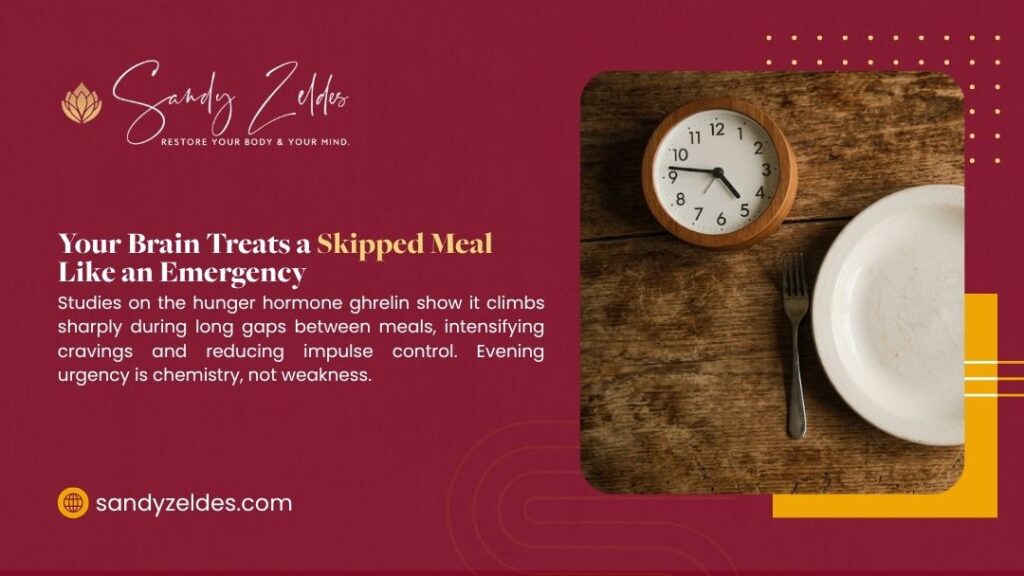
Long gaps between meals, skipped lunches, and overly rigid eating windows signal scarcity to your brain. By the time evening arrives, the urgency you feel is not weakness. It is a physiological response to a day of perceived deprivation.
This does not mean following a strict meal plan. It means eating enough, regularly enough, that your body does not shift into survival mode.
When blood sugar stays stable and physical hunger is consistently met, food becomes less emotionally loaded. Cravings quiet down because your body is no longer operating in a state of emergency.
Use a Pause Before Reacting to Food Urges
When a craving arrives, try a 10-second pause before reaching for food. Ask yourself what you are physically feeling, what emotion is present, and whether food is truly the only option available to you right now.
You are not trying to suppress the urge. You are trying to understand it. That single gap between impulse and action can shift an automatic behavior into a conscious choice.
EFT for emotional eating works directly on this dynamic. Rather than relying on willpower to push the urge down, it addresses the emotional charge behind the craving, which is exactly why I return to it so consistently when working with clients.
Replace the Coping Function, Not Just the Food
If food is providing comfort, distraction, or relief, removing the food without replacing what it offers will not hold long-term. It usually makes the urges stronger.
Ask yourself honestly what food is doing for you in those difficult moments. Is it providing a mental break? Numbing something uncomfortable? Giving you a moment of pleasure in an otherwise relentless day?
Those are real needs. They deserve real responses.
Consider these alternatives when the urge peaks:
- Reaching out to someone you trust
- Taking a short walk or changing your physical space
- Writing down what you are feeling without judgment
- Sitting quietly with something warm to drink for five minutes
These are not tricks to suppress cravings. They are actual forms of relief that meet the underlying need. EFT for food cravings goes one step further by targeting the emotional state driving the urge directly, often reducing the craving without any force or restriction involved.

Rebuild Trust After a Slip
Most people respond to overeating with self-criticism, shame, and a commitment to restrict harder tomorrow. That response almost always sets up the next episode.
Instead, acknowledge what happened without layering judgment on top of it. Ask what you were feeling or needing at that moment. Then return to your next meal normally, without skipping, compensating, or punishing yourself for what happened.
One episode does not erase your progress. The choice you make next is where the new pattern actually builds.
When to Get Support and What Recovery Can Look Like
Not every struggle with food requires professional support. But some do, and recognizing the difference matters.
Signs It May Be Time to Seek Help
- Episodes of loss of control feel frequent, automatic, or emotionally overwhelming
- Eating has become secretive or connected to significant shame
- Food-related thoughts consume a large portion of your mental day
- You have tried multiple approaches on your own and the pattern keeps returning
- The behavior feels tied to anxiety, trauma, perfectionism, or a deep sense of low self-worth
These signs do not mean something is permanently wrong with you. They mean the pattern has roots deeper than food behavior alone, and those roots respond far better to proper support than to more self-discipline.
What Support May Include
Recovery from emotional eating or disordered eating often combines several elements:
- Nutritional guidance that removes restriction and supports biological stability
- Emotional processing work to address the feelings driving food behavior
- Approaches like EFT or trauma-informed coaching that reach the subconscious layer beneath the surface behavior
Healing does not look like eating perfectly. It looks like fewer spirals, less mental noise around food, and a growing sense of self-trust. That is possible, and it is closer than it might feel right now.
Frequently Asked Questions
Why Do I Feel Out of Control Around Food Even When I’m Trying Hard?
Trying harder does not change the underlying drivers. If restriction, emotional stress, or shame are at the root of the pattern, adding more effort to control food typically intensifies the problem rather than resolving it. The behavior is a signal, not a discipline failure.
Is this emotional eating or binge eating disorder?
Emotional eating means using food to manage feelings rather than physical hunger. Binge eating disorder is a clinical condition involving repeated, compulsive eating episodes followed by significant distress.
They share some features but differ in frequency, intensity, and functional impact. A professional evaluation can help clarify which pattern fits your experience.
Can skipping meals make me feel out of control later?
Yes, research links dietary restriction during the day to a higher risk of loss of control eating in the evening. Long gaps between meals and overly rigid eating patterns create a deprivation response that makes urges harder to manage by the time you sit down to eat.
Why do I only lose control at night?
Nighttime loss of control usually reflects cumulative stress, emotional depletion, and the physical restriction that built up across the day.
After hours of holding everything together, the brain reaches for its most reliable source of relief. It is a pattern with a clear behavioral cause, not a moral one.
How do I stop feeling obsessed with food?
Food obsession tends to reduce when you eat enough consistently, remove rigid food rules, and address the emotional patterns underneath the behavior. Adding more control rarely quiets the mental noise. Reducing the emotional charge around food almost always does.
Create a Calmer, More Trusting Relationship With Food
For over 20 years, I have worked with women to help them understand and heal the emotional and subconscious patterns behind their relationship with food.
My approach brings together holistic nutrition, EFT, and energy psychology to address what years of dieting could never reach.
The women I work with are entrepreneurs, artists, executives, and caregivers who have tried every approach available and found the missing piece was never the food plan itself.
I offer one-on-one coaching sessions, online courses, and my highly rated DailyOM course, “Heal Subconscious Blocks to Weight Loss,” which held the number one ranking on the platform for over eight consecutive weeks.
If what you read here resonated with you, reach out to me to explore which approach fits where you are right now. You do not need to have it all figured out before you start.